By Sami Zaptia.
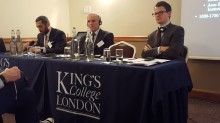

Rebuilding Libya’s unified army is going to be a big challenge. It cannot be done in the short term, but that does not prevent work starting, former Libyan Chief of Staff Yousef Mangoush said Friday.
Rebuilding a national army is seen as a means of achieving security for Libya with its widespread dispersion of weapons. However, its rebuilding has been one of the most contended issues in Libya over the last five years, Mangoush explained, speaking exclusively to Libya Herald on the margins of a conference organized by King’s College on Libyan security in London.
The contentious issue is whether to include soldiers who were part of the Qaddafi army in the new post February 17th 2011 revolution army. The fighters who took part in the revolution object to including Qaddafi’s former soldiers in this new army.
The army needs a total overhaul and reform, including its pay structure. A smaller, well equipped, more effective rapid intervention force needs to be created of no more than 60,000 soldiers. The new army needs to be loyal to the nation and not the tribe, city or region, and be controlled by the legitimate civilian power, he said.
When asked by Libya Herald whether this would take too long to build while Libya needs urgent action today, Mangoush said that in the meantime an even smaller ‘‘force’’ needs to be created of about 3,000 to 4,000 to be able to act quickly. He felt this was achievable.
Mangoush said that the new army needed to include some members of the militias/thuwar who wish to enlist but only those who actually took part in the revolution. Some army members from the former regime cannot be marginalized and must be considered for enlisting in a new army, he added.
Militiamen need to be reintegrated as individuals into the army and not their whole militias. This was where the 2012 reintegration effort failed, he explained.
Reviewing the history of the Libyan army, Mangoush said that the Libyan army was created in 1940 in Egypt with British support. It participated in World War II until the defeat of the Axis powers. At the end of the War, the army was disbanded. After Libya gained independence as a Kingdom the army was re-established in 1953, he explained.
In 1969, when Qaddafi came to power, the Libyan army had 650 officers and 10,000 soldiers and at the end of his regime in February 1969 the army had 18,000 officers and 120,000 soldiers. Mangoush felt that the 1969 army was more effective than the 2011 army, which Qaddafi had deliberately neglected and weakened.
Qaddafi had also deliberately refrained from creating a ministry of defence, putting the army under the Temporary Defence Committee. This meant that by 2011 the army did not have strong structures and cadres.
On the failure of post 2011 Demilitarization, Demobilization and Reintegration (DDR) efforts, Mangoush said that the volume of weapons widely distributed in Libya was the reason DDR had failed. There are more arms dispersed in the country now than the Qaddafi army had, he explained. A normal DDR programme could not succeed, he explained. Equally, the reality on the ground in Libya at the time prevented DDR, with various clashes ongoing across the country.
These clashes meant that no region was prepared to give-up its arms, which has had a negative effect on the state and its rebuilding. The various contending parties see their arms as the means of guaranteeing the success of the 17th February revolution.
Explaining why the unelected political leadership of the revolution – the National Transitional Council (NTC) – had created the Libya Shields (regional militias) and legalized the various militia groups at the time, as opposed to demobilizing and reintegrating them, Mangoush said that the NTC had hoped to control the militias. However, he admitted that there were too many weapons and militias for the NTC to be able to exert control.
Today, Mangoush said that approximately two-thirds of Libya’s armed militias and infrastructure are based in the west of Libya while a third can be found in the east.
During the 2011 revolution, some of Qaddafi’s army played an active part in overthrowing him, but some chose to stay at home and played no part. Most of the fighters in 2011 were civilians who have a negative view of Qaddafi’s army, and especially those who did not actively participate in overthrowing the regime during the revolution.
They resisted their reintegration into a new army and this is affecting the rebuilding of the new army.
Mangoush admitted that today while the fighters/militias are recognized by the various contending Libyan authorities, they are not under their control.
The army is top heavy, he explained with the top ranks forming 85 percent while the lower ranks form 15 percent. Those who are over the retirement age constitute over 25 percent of the army. Many of these have not had any recent or modern training for years, he added.
Rebuilding an army will be difficult while the country is politically polarized and while there is duplication of command structures. He noted how both the contending sides see themselves as fighting the enemy or the extremists and see each other as the enemy.
Libya itself needs to have a clear national vision so that the role of its army is clear. The country needs a security vision. There needs to be a comprehensive policy, he explained.
Noting a possible contradiction, Libya Herald asked if Libya needed to agree a social contract prior to creating a unified army, Mangoush said that the rebuilding of a small force and then an army must start immediately. It could not wait for the country to agree on a broader social contract. Both efforts must happen in tandem, he felt.
Mangoush said that the army under Hafter in the east has failed to achieve its stated aim (of eradicating the east of what it calls extremists), whilst extremists have succeeded in Sabratha, Sirte and Derna. He said that realistically, Hafter had to have a role in Libya’s new army, but did not elaborate further.
Major General Yousef Mangoush was appointed as Chief of Staff in January 2012. He resigned on 9 June 2013 following the deaths of 31 people in clashes between members of the First Brigade of the Libya Shield Forces (Deraa 1) and protestors who were demonstrating outside the brigade’s Benghazi headquarters, demanding the force be disbanded.
The General National Congress had accepted his resignation as he had become widely unpopular with public demonstrations for his removal because of what was seen as his failure to rebuild the Libyan army and to prevent the assassinations in Benghazi.
Congress had appointed General-Major Salem Gnaidi as acting chief of staff. He was succeeded in a full time role by Colonel Abdulsalam Jad Allah Al-Salheen Al-Obaidi in July 2013.