No Result
View All Result
Tuesday, April 7, 2026
23 °c
Tripoli
24 ° Sat
24 ° Sun
  • Advertising
  • Contact
LibyaHerald
  • Home
  • Libya
  • Business
  • Opinion
  • Magazine
  • Advertising
  • Login
  • Register
SUBSCRIBE
  • Home
  • Libya
  • Business
  • Opinion
  • Magazine
  • Advertising
  • Login
  • Register
No Result
View All Result
LibyaHerald
No Result
View All Result
Home Libya

Libya’s prison and detention system is in chaos: report

bySami Zaptia
September 4, 2016
Reading Time: 2 mins read
A A
Libya’s prison and detention system is in chaos: report

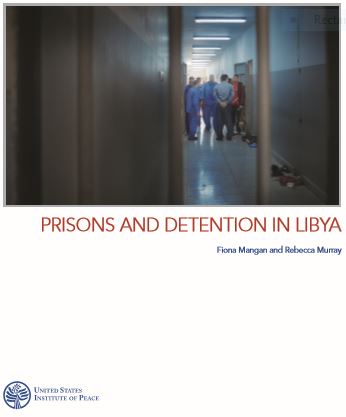
The USIP report says Libya's prisons are in chaos (Photo: USIP).

By Sami Zaptia.

The USIP report says Libya's prisons are in chaos (Photo: USIP).
The USIP report says Libya’s prisons are in chaos (Photo: USIP).

London, 4 September 2016:

Libya’s prisons and its detention system is in chaos, and earlier hopes for reform have faltered, a United States Institute of Peace (USIP) report authored by Fiona Mangan and Rebecca Murray published Friday says.

The report examines the Libyan prison system with the permission of the Libyan Ministry of Justice and Judicial Police. Its research teams conducted two assessments of the Libyan prison system, visiting detention facilities throughout the country in 2012 and again in 2015–16 to evaluate organizational function, security, infrastructure, and prisoner well-being.

The report combines and compares the findings of the two assessments, discussing the broader context of detention issues in Libya, with analysis centering on prisons under the authority of the Ministry of Justice and operated by the Judicial Police.

RELATED POSTS

Minister of Labour and Rehabilitation participates in workshop on the National Project for Rehabilitation and Integration

UNDP and USIP workshop on reunification of Libyan institutions

The report concludes that the turmoil of the 2011 revolution and the subsequent emergence of two governments have created a splintered system struggling to cope with structural, security, and budgetary challenges.

Prisons are run not only by different branches of the rival governments but also by politically aligned armed groups outside the state’s purview, it reports.

State-run facilities often rely on armed groups to help guard against attacks on prisons and on convoys transporting inmates to and from courts and hospitals.

The USIP says that its assessment teams visited about twenty facilities in different parts of the country in 2012 and again in 2015–16, interviewing prison officials, government officials, human rights activists, and other national and international actors.

The teams found prison directors trying to improve the well-being of both staff and inmates but struggling with scant resources, dilapidated facilities, and multiple security threats.

It says staff must contend with unreliable salary payment, uncertain chains of command, and little training. It also says that the integration of members of revolutionary armed groups into the Judicial Police has been slow and complex.

It reports that most prisoners are detained without being prosecuted or sentenced—mired within a stalled judicial process.

In Libya’s post-conflict environment, the report says, guards may see prisoners not just as detainees but as “enemies,” and vice versa, exacerbating problems of prison management. Moreover, many inmates are not “ordinary” criminals but conflict-related or political detainees.

Inmates typically live in overcrowded facilities, a number of them not originally designed as prisons and consequently unable to provide adequate sanitation, exercise facilities, and medical services.

Older inmates (including officials of the former regime), juveniles, female prisoners, and foreign prisoners face additional challenges.

A variety of reforms to the prisons and detention system are urgently needed, ranging from major legislative reforms—such as rewriting the law that governs the system—to bureaucratic measures—such as improving reporting procedures to facilitate strategic data-driven prison system management, the report says.

In spite of challenges posed by ongoing conflict, prison directors must take responsibility for improvements to prisoner care within their reach. Nonetheless, prospects for deeper institutional reform depend on local and international actors helping prison officials holding the system together until political stability can be restored and detention regularized, concludes the report.




Tags: Choucha refugee campdetention centresfeaturedprisonsUnited States Institute for Peace USIP

Related Posts

Military Intelligence Chiefs Conference for the Sahel and Mediterranean countries 2026 held in Tripoli
Libya

Military Intelligence Chiefs Conference for the Sahel and Mediterranean countries 2026 held in Tripoli

April 6, 2026
Transport Ministry meets Japanese company North Star interested in investing in Libya
Libya

Latest developments regarding tanker “Badr”, being detained by Bulgaria in port of Burgas, discussed.

April 6, 2026
Tripoli Chamber of Commerce to hold seminar with Embassy of China on 12 April on strengthening bilateral trade
Libya

Tripoli Chamber of Commerce to hold seminar with Embassy of China on 12 April on strengthening bilateral trade

April 5, 2026
Transport Ministry meets Japanese company North Star interested in investing in Libya
Business

Libya and Turkey discuss increasing flights, including to Sebha

April 4, 2026
ESDF and subsidiary LIDCO hold meeting with KPMG to follow up on financial evaluation within ESDF’s programme for subsidiary companies
Libya

LIDCO discusses with Turkey mechanisms to reactivate stalled projects and new projects

April 4, 2026
Civil Aviation Risk Assessment company Med Air inspects Tripoli’s Mitiga Airport
Business

Mitiga airport completes preparations to receive Air Cairo flights

April 4, 2026
Next Post

Sanalla suggests direct oil income for NOC, accuses PFG of massive numbers exaggeration

Zubi reported free after two years' captivity

Top Stories

  • HSC‘s National Accord Bloc calls on relevant authorities to act against the ”corrupt and illegal” Arkenu Oil Company

    Aldabaiba instructs CBL to terminate Arkenu Oil Company’s oil sales agreement

    0 shares
    Share 0 Tweet 0
  • Belgasem Hafter reneges on US-brokered agreement by refusing to cut development spending – sends dinar crashing

    0 shares
    Share 0 Tweet 0
  • Libya to host for first time part of Flintlock 2026 multinational military exercises in mid-April

    0 shares
    Share 0 Tweet 0
  • Libyan dinar will be down to LD 7.90 before mid-April: CBL briefing

    0 shares
    Share 0 Tweet 0
  • Tunisia’s New African Transit Corridor via Ras Jedir: An Opportunity for Libya to Become a Trade Gateway to sub-Saharan Africa

    0 shares
    Share 0 Tweet 0
ADVERTISEMENT
LibyaHerald

The Libya Herald first appeared on 17 February 2012 – the first anniversary of the Libyan Revolution. Since then, it has become a favourite go-to source on news about Libya, for many in Libya and around the world, regularly attracting millions of hits.

Recent News

Military Intelligence Chiefs Conference for the Sahel and Mediterranean countries 2026 held in Tripoli

Latest developments regarding tanker “Badr”, being detained by Bulgaria in port of Burgas, discussed.

Sitemap

  • Why subscribe?
  • Terms & Conditions
  • FAQs
  • Copyright & Intellectual Property Rights
  • Subscribe now

Newsletters

    Be the first to know latest important news & events directly to your inbox.

    Sending ...

    By signing up, I agree to our TOS and Privacy Policy.

    © 2022 LibyaHerald - Powered by Sparx Solutions.

    Welcome Back!

    Login to your account below

    Forgotten Password? Sign Up

    Create New Account!

    Fill the forms below to register

    *By registering into our website, you agree to the Terms & Conditions and Privacy Policy.
    All fields are required. Log In

    Retrieve your password

    Please enter your username or email address to reset your password.

    Log In
    No Result
    View All Result
    • Login
    • Sign Up
    • Libya
    • Business
    • Advertising
    • About us
    • BusinessEye Magazine
    • Letters
    • Features
    • Why subscribe?
    • FAQs
    • Contact

    © 2022 LibyaHerald - Powered by Sparx Solutions.

    This website uses cookies. By continuing to use this website you are giving consent to cookies being used. Visit our Privacy and Cookie Policy.