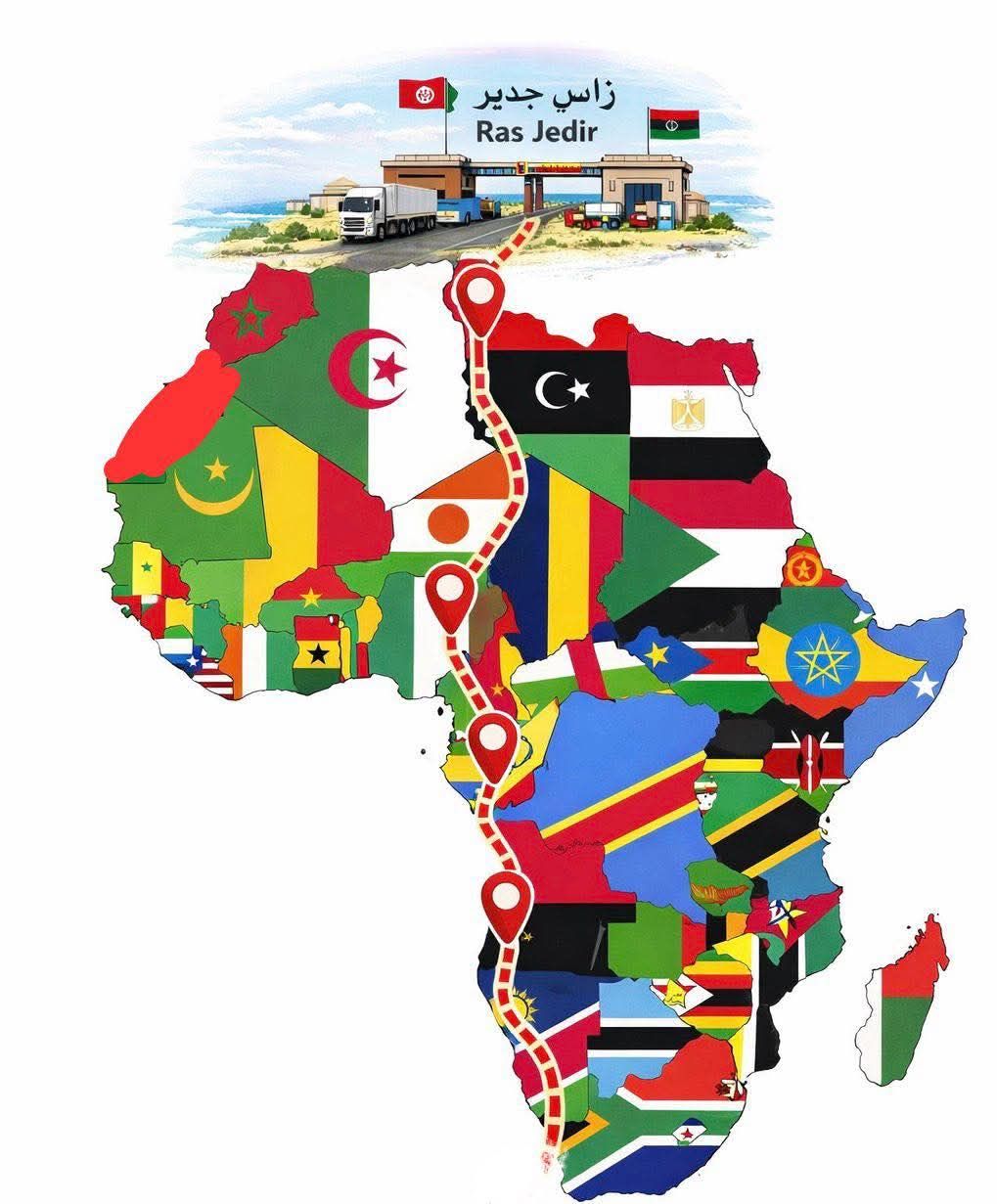
Tunisia has announced the launch of a continental land transit corridor project starting from Libya’s Ras Jedir border crossing with Tunisia, towards sub-Saharan African countries such as Niger, Chad, Mali, Burkina Faso, and the Central African Republic.
The launch of the project reflects a clear strategic move towards the African interior. At the same time, it opens a significant opportunity for Libya to capitalize on its geographical location and strengthen its role as a hub for regional trade.
The project, which aims to reduce the cost and time of exports, improve logistics services, and enhance economic integration within the continent, reflects a Tunisian economic vision that seeks to expand its presence in African markets, taking advantage of the African Continental Free Trade Area (AfCFTA).
Furthermore, the registration of hundreds of export operations for value-added products confirms that this approach is not limited to political ambitions but is based on an industrial production base seeking to penetrate new markets on the continent.
A real opportunity for Libya?
Although the initiative originated from the Tunisian side, the passage of this corridor through Libyan territory gives Libya a real opportunity to become a logistics hub linking Mediterranean ports with sub-Saharan African markets.
This could boost trade and increase land transport and logistics activity within the country. The project could also pave the way for the establishment of commercial and industrial zones along the route, revitalizing Libyan ports and making them a gateway for goods arriving from Europe and destined for the Sahel region of Africa. Furthermore, it could boost intra-African trade with vast, largely untapped African markets.
Added value for Libya?
Thus, the true economic value of this corridor for Libya lies not only in its role as a transit route, but also in its potential to become an integrated economic platform that supports economic diversification and creates new investment opportunities in the transport, logistics, and regional trade sectors, provided this opportunity is capitalized upon within a clear economic vision.
Libya’s existing vision for transit trade
It is worth noting that Libya already has a vision and existing projects related to continental roads. Given the rapid economic transformations within the African continent, the need to develop a continental road network linking North Africa with the Sahel and the African interior is becoming increasingly apparent. This presents Libya with a strategic opportunity to leverage its geographical location as a link between the Mediterranean and African markets. The proposed Libyan vision is based on developing a network of land corridors that could become major arteries for trade and transport between North and South Africa.
The Tripoli-Sebha-Niger Corridor
This route is one of the most important proposed routes for connecting western Libya with West African countries via Niger. It could form a trade corridor linking the ports of Tripoli and Misrata to the markets of the African Sahel, thus contributing to reducing transport time and shipping costs.
The Benghazi-Kufra-Chad Corridor
This route represents the gateway for eastern Libya to Central Africa. The road extending from Benghazi to Kufra, reaching the Chadian border, could be developed into a major corridor for transporting goods and commodities to markets in the heart of the continent.
The Kufra-Sudan Corridor
This route would enhance trade between Libya and Sudan and open the door to broader trade with East African countries, in addition to supporting overland transport and the exchange of agricultural and food products.
Connecting Libyan Ports to African Corridors
The vision also includes transforming Libyan ports, such as Tripoli, Misrata, and Benghazi, into major launching points for goods destined for Africa by connecting them to a modern road network extending to the Sahel countries.
Establishing Logistics Hubs Along Continental Routes
The proposed plans include establishing logistics zones, storage centers, and transport services along these routes, which will enhance transit traffic and attract investment in the transport and services sector.
Developing Southern Border Crossings
Upgrading the infrastructure of border crossings in southern Libya is a key part of this vision, aiming to facilitate the movement of trucks and transit trade between Libya and its African neighbours.
Observers believe that implementing such projects would transform Libya into a major gateway for trade between Europe and Africa and strengthen its role in regional supply chains, especially given the growing importance of the African Continental Free Trade Area (AfCFTA) and the opportunities it offers for expanding intra-African trade.
.
First Chinese ship loaded with ‘‘transit trade’’ containers docks at Misrata Free Zone
Symposium on ‘‘Transit Trade and Logistics Transformation’’ held in Tripoli on 23 September
Chad signs agreement with Egypt to construct Chad section of the Egypt-Libya-Chad Transit Road
Eastern Libya signs MoU to construct its section of the Egypt – Libya – Chad Transit Road Project
Tripoli Transport Minister seeking to activate Transit Roads to Niger and Sudan
Transport Minister discusses ‘‘practical steps’’ for transit road project with Niger
Libya and Niger sign transit road implementation MoU
Implementation timetable set for Libya to Niger, Libya to Sudan Transit Roads projects
Tripoli Transport Minister seeking to activate Transit Roads to Niger and Sudan
Libya discusses with Chad direct flights and the Transit Trade Road
Benghazi’s Jiliana Free Port continues transit trade to Chad
Transit Trade: First transshipment operation from Jiliana Free Zone, Benghazi, to Europe
Preparations for the second ‘‘Made in Libya’’ edition in Niamey, Niger progressing (libyaherald.com)