By Chris Stephen.

Benghazi, 7 October:
Last week under a bright blue sky, half a dozen land cruisers escorted by a police motorcade arrived outside the gates of the abandoned US consulate in Benghazi.
FBI agents spilled out and three snipers took up positions on the roof of the burned-out villa. More than one Benghazi resident wondered where all that security had been when it was needed.
US Congress will on Wednesday question the chief of security for the consulate on why, given a string of previous attacks on diplomatic targets in Benghazi, security had not been tightened to resist the assault that killed ambassador Chris Stevens and three of his officials.
The build up
Attacks on foreign missions burst into life in Benghazi in April when a bomb was thrown at a UN convoy. In May, a rocket hit the office of the International Committee of the Red Cross and on 6 June a bomb exploded outside the US consulate.
Then on 11 June, a rocket struck a vehicle in the convoy of Britain’s Libya ambassador, Sir Dominic Asquith, wounding two security officers, outside the UK consulate.
The UK closed its consulate soon afterwards. On 18 June, gunmen stormed the Tunisian consulate and burned the flag in protest against an art exhibition that had opened in Tunis. In August, the ICRC announced that, after five attacks on its offices in Libya, it was closing bureaus in Benghazi and Misrata.
Throughout the same period Benghazi also saw 14 assassinations of former Qaddafi-era officials.
Security
US embassies around the world are a by-word for security and most are veritable fortresses. Not so the Benghazi consulate.
It consists of a collection of buildings sitting amid bean fields surrounded by a wall in Fuwaihat, a southern suburb of flat farmland dotted with compounds of the wealthy.
The front wall has barbed wire above it, but the back wall has none and is low enough to clamber over with ease. By contrast, the abandoned UK consulate, visible half a mile away across the fields, has 15 foot walls, a watchtower and blast walls made of sandbags stacked in steel cages.
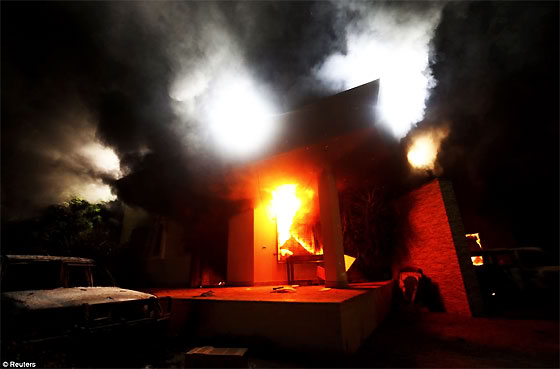
The villa at the centre of the complex has steel doors, grates over all but one of the windows - the one leading to the Safe Room - and two sandbagged emplacements outside. Inside a steel door protects a Safe Room - actually a group of rooms, in which Stevens died of smoke inhalation.
But the Safe Room had a fatal flaw. Such places are intended not to stop an attack but delay it long enough for a relief force to materialise.
There is no central control over Benghazi security, which is shared with haphazard coordination among police, military police, army, various militias and the Supreme Security Council (SSC), the national gendarmerie.
Fawzi Younis Qaddafi, no relation to the former dictator, is commander of the Benghazi SSC, and said he was not told that the ambassador was at the residence beforehand or when a frightened diplomat called to say it was under attack.
The attack
Witnesses agree that the attack on the compound began shortly after 21:30 on 11 September.
Attackers massed at the twin front gates, along a narrow unmade road, and by the twin rear gates, which leads onto the main highway. There were many spectators, as the rear gates are across the street from the fashionable Venezia restaurant. If there was a protest, as Washington at first claimed, then it was by the attackers themselves.
Grenades were thrown over the front wall. Shortly afterwards, an unarmed Libyan consulate guard opened one of the back gates. The group of eight to twelve gunmen standing there shouted at him to get back inside. Shortly afterwards they opened fire at the gate, which has 22 bullet holes. Another five bullet holes show fire being returned from inside.
Seven or eight Americans in the compound bundled themselves into an armoured jeep which drove out, sustaining fire, and made it to the annex, an accommodation compound a mile away by road. Left behind in the villa was ambassador Stevens who had locked himself in the Safe Room.
The biggest mystery for anyone touring the compound is the absence of battle damage. The buildings are charred, along with three embassy pickup trucks, from arson, but there are few bullet strikes. If the attackers entered before the staff had fled, it seems there was no exchange of fire.
A rocket propelled grenade was fired at the double doors of the villa, missing and striking the lintel above. Apparently the shock was enough to force open the doors. But it is unclear if an attempt was made to break into the Safe Room, or if the attackers even knew it was there.
Younis Qaddaffi said his units turned up at the villa but insists he was not told that the ambassador was missing. By then large crowds of the curious had turned up and he decided to leave the scene.
It was those crowds that found Ambassador Stevens, either dead or dying from smoke inhalation, shortly after midnight. Benghazi Medical Centre records him arriving, dead, by private car along with an injured guard around 01:00.
By this time a team of eight U.S. officials, some armed, had been despatched by helicopter from Tripoli. They arrived at 01:30. and went to the annex building.
Then, sometime in the early hours, mortar rounds slammed into the roof of the annex, killing two former navy Seals, Tyrone Woods and Glen Doherty.
According to the two landlords, the annex was not, as some reports claim, a Safe House, being neither secure nor secret. It was where most of Benghazi’s US diplomats lived.
Also killed that night from smoke inhalation was Sean Smith, a foreign service information officer, though again the circumstances of his death have yet to be fully explained.