No Result
View All Result
Monday, December 1, 2025
23 °c
Tripoli
24 ° Sat
24 ° Sun
  • Advertising
  • Contact
LibyaHerald
  • Home
  • Libya
  • Business
  • Opinion
  • Magazine
  • Advertising
  • Login
  • Register
SUBSCRIBE
  • Home
  • Libya
  • Business
  • Opinion
  • Magazine
  • Advertising
  • Login
  • Register
No Result
View All Result
LibyaHerald
No Result
View All Result
Home Libya

Grand Mufti describes Libya’s political system as “a failed experiment”

byGeorge Grant
October 22, 2012
Reading Time: 3 mins read
A A

By Valerie Stocker.

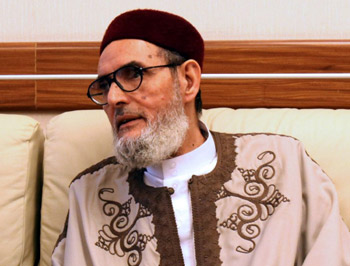
Sheikh Sadiq Al-Ghariani describes the new political system as “a failed experiment”.

Tripoli, 22 October:

Libyans will have to pay the price of their hypocrisy, says Sheikh Sadeq Al-Ghariani, referring to a . . .[restrict]multi-party system he deems unsuitable for the country.

In a commentary entitled “Latest Surprises from the General National Congress”, Ghariani criticises the people and parties that currently make up the National Congress and calls the political system created in the aftermath of the revolution “a failed experiment”.

The first “surprise” Ghariani points out is the fact that the two rivalling factions within the Congress eventually managed to agree on Ali Zidan to be Libya’s next Prime Minister after having dismissed Mustafa Abushagur in a vote of no-confidence seven days earlier.

RELATED POSTS

Aldabaiba proposes new Road Map for holding elections, loans and land for youth and money for healthcare for war wounded

Cooperation agreements reached between Libyan and the Greek pharmaceutical and medical companies: Tripoli Chamber of Commerce

Also surprising, he says, is the unprecedented soberness or detachment with which they made this choice, considering how fiercely the political forces had been competing against each other previously. This, he argues, proves that both sides wanted an independent broker to head the future government, one who did not clearly belong to either of the factions.

But the decision was not reached without controversies, as lengthy debates arose within the Congress over how to define “independent”: Is it formal criteria such as a candidate’s official position that matter or does the issue really come down to his personal attitude, no matter what or who he previously represented? This is not a theoretical question as Libyans disagree on whether ministers should renounce their membership of a political party before coming into office, which is what they are currently required to do.

Following these rather positive remarks Ghariani gets down to his actual mission, which is to point out the shortcomings of Libya’s new system of government and its current representatives.

While Congress members proved their maturity and impartiality by choosing Ali Zidan as prime minister, their move was in fact an admission that the political entities are weak and unable to govern the country at this stage. One reason for these shortcomings is Libya’s lack of experience with political parties, whose creation should have been postponed until after a Constitution is drawn up, he argues.

Party politics has resulted in quarrels, self-interest seeking and regionalism within the Congress, to the point where “principles were sacrificed for the sake of partisan and regional gains”. There is no lack of examples that illustrate the weakness of the GNC, he says.

Lack of transparency seems to be Ghariani’s main concern, as he points out that the Congress still operates without a proper government, making it difficult to implement decisions and follow up how public funds are being spent, and that little is known even about the Congress members themselves. “Are the Congress members aware of what is going wrong or will it come as a surprise to them some day?” he wonders.

The main problem, according to the grand mufti, is what he sees as an imposed multi-party system.

Whilst some members of the old National Transitional Council were enthusiastic about the idea, they failed to convince the other side. “(Even) the media, who initially supported it, now acknowledge the experiment is a failure”, he claims.

He also criticises the way this system was put into practice, in particular the rules that were set up to select candidates and establish party lists: “For some parties it became a matter of filling in blanks only to comply with the rules!… The voters were left to choose between the unknown and the stroke of luck… just as gambler who doesn’t know what he gets on his hand”, he says. They were duped into believing that they voted for highly qualified candidates only to find out later that those representing them were nothing but common people.

“Expecting a male candidate, they eventually got a woman, or the other way round!”, he protests. As a result, he argues, many congressmen took office without a real programme and then engaged in political horse-trading, since “every Congress seat has its price and value”.

Nevertheless, Ghariani thinks that a closed-list party system can work in a country with a stable and transparent political regime in which voters are well informed about party programmes and have the experience required to make the right choices.

Libyans, however, made the mistake of “climbing the ladder from above so that they could not be accused of opposing democracy or the participation of women in politics” and will have to “pay for this leap” before even acquiring the basics. “I could say [we will pay] the price of our hypocrisy’”, he concludes.

[/restrict]

Tags: featured

Related Posts

Attorney General orders arrests at Jumhouria bank branch for embezzlement
Libya

Detention of a former chairman of Libya Telecom & Technology Company for LD 20 million misappropriation

November 28, 2025
“Beaches and marine life: Between investment and environmental conservation. Towards more sustainable eco-tourism” debate held in Tripoli
Libya

Tourism Minister affirms full support for Second Fesania Desert Rally scheduled to begin on 1 January in Wadi al-Hayat

November 28, 2025
Interior Ministry’s Diplomatic Missions Protection personnel receiving training in Ukraine
Libya

Security plan within Tripoli has resulted in the resolution of several cases: Interior Minister Trabelsi

November 27, 2025
Attorney General orders arrests at Jumhouria bank branch for embezzlement
Libya

Detention ordered of Director General and Director of Finance of Libyan Post, Telecoms and Information Technology Holding Co. for fund mismanagement

November 27, 2025
GNU to take oath at Benghazi HoR session and budget to be approved at Tripoli session: GNU
Libya

Aldabaiba holds meeting with Interior Minister Trabelsi and Undersecretary of Defence Zoubi to follow up on ‎‎security and military developments

November 27, 2025
Attorney General orders arrests at Jumhouria bank branch for embezzlement
Libya

Former Director of Long-Term Investment Portfolio’s Housing Company for Tourism and Hotel Investments to be detained for misappropriation of US$ 15 million

November 26, 2025
Next Post
The change in prime minister: constitutionally, the system worked perfectly

The change in prime minister: constitutionally, the system worked perfectly

Libya needs a weapons collection policy that can work

libyaherald-Ads

Top Stories

  • LBBC concludes productive Benghazi visit strengthening UK-Libya business collaboration

    Libya’s energy transition represents one of North Africa’s most significant infrastructure opportunities: LBBC Chairman Peter Millett

    0 shares
    Share 0 Tweet 0
  • ‘‘Serious interest from American companies in returning to the Libyan market confirms their confidence in the path of reform and stability’’

    0 shares
    Share 0 Tweet 0
  • Security plan within Tripoli has resulted in the resolution of several cases: Interior Minister Trabelsi

    0 shares
    Share 0 Tweet 0
  • Seventy percent of waste is recyclable and can earn money – councils must work with the private sector to solve their recycling problems

    0 shares
    Share 0 Tweet 0
  • Libya needs over one million housing units over next 10 years costing over 200 billion dinars

    0 shares
    Share 0 Tweet 0
ADVERTISEMENT
LibyaHerald

The Libya Herald first appeared on 17 February 2012 – the first anniversary of the Libyan Revolution. Since then, it has become a favourite go-to source on news about Libya, for many in Libya and around the world, regularly attracting millions of hits.

Recent News

Dialogue session held on “Governmental and Non-Governmental Sukuk-Bonds” as innovative financing tools for economic growth

Misrata Free Zone port strengthens its regional position by receiving a new shipping line

Sitemap

  • Why subscribe?
  • Terms & Conditions
  • FAQs
  • Copyright & Intellectual Property Rights
  • Subscribe now

Newsletters

    Be the first to know latest important news & events directly to your inbox.

    Sending ...

    By signing up, I agree to our TOS and Privacy Policy.

    © 2022 LibyaHerald - Powered by Sparx Solutions.

    Welcome Back!

    Login to your account below

    Forgotten Password? Sign Up

    Create New Account!

    Fill the forms below to register

    *By registering into our website, you agree to the Terms & Conditions and Privacy Policy.
    All fields are required. Log In

    Retrieve your password

    Please enter your username or email address to reset your password.

    Log In
    No Result
    View All Result
    • Login
    • Sign Up
    • Libya
    • Business
    • Advertising
    • About us
    • BusinessEye Magazine
    • Letters
    • Features
    • Why subscribe?
    • FAQs
    • Contact

    © 2022 LibyaHerald - Powered by Sparx Solutions.

    This website uses cookies. By continuing to use this website you are giving consent to cookies being used. Visit our Privacy and Cookie Policy.