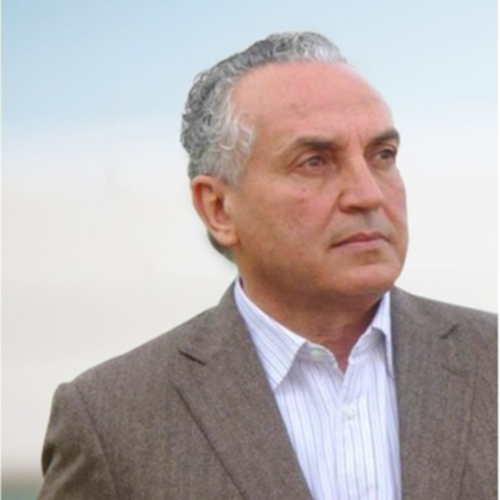
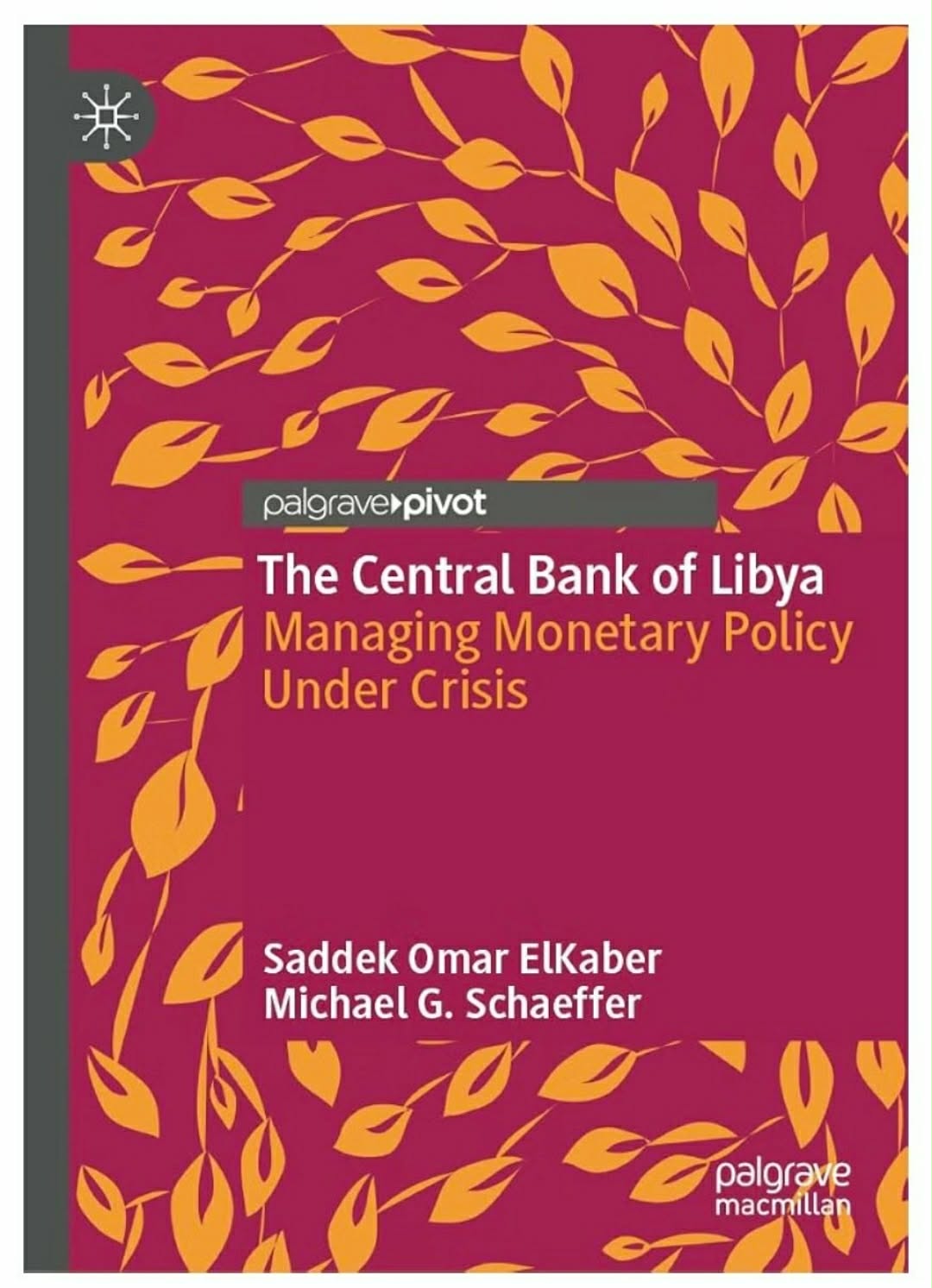
I have read with interest about the imminent publication in November this year of the book ‘‘The Central Bank of Libya: Managing Monetary Policy Under Crisis’’, co-authored by former Governor of the Central Bank of Libya (CBL), Saddek Omar Elkaber and Michael G. Schaeffer (former Libya Country Representative for the World Bank and former Public Sector Adviser for the World Bank in Libya) and published by Palgrave Macmillan.
According to the publisher’s description, the book examines the evolution of monetary policy and the Central Bank of Libya during a period marked by political and institutional division and successive crises.
In principle, I welcome any serious work that documents the management of Libya’s most important monetary institution during one of the most difficult periods in the country’s history. A written account by the person who headed monetary policy throughout those years is undoubtedly important for researchers and the wider public.
However, the book should not be read as the final judgment on that experience, but rather as the account of one of its principal participants.
The management of a central bank should not be assessed by intentions or the size of foreign reserves alone. It must also be judged by the results of monetary policy: the value of the currency, price stability, money supply, the soundness of the banking system, citizens’ access to their own funds, and the degree of coordination between monetary and fiscal policy.
First: The 2014 Crisis and the Banking Clearing System
One of the central questions that cannot be overlooked when assessing this period concerns what happened to Libya’s banking system following the political division of 2014.
Published research and reports document the separation of the Benghazi CBL branch from the central settlement system in Tripoli within the context of the political and institutional split, with the stated purpose of preventing the authorities in the east from accessing government accounts and funds.
This was therefore not merely a technical banking matter. The economic question that should be asked is: What was the cost to the Libyan economy, commercial banks and depositors of dividing the settlement and clearing system? And did protecting public funds necessarily require disrupting the unity of the banking system, or were less costly supervisory alternatives available?
These are legitimate questions that Libya’s economic history should answer, away from political alignment.
Second: Defending the LYD 1.40 Exchange Rate
As oil revenues declined and fiscal deficits emerged after 2013, it gradually became evident that the official exchange rate no longer reflected the balance between the volume of Libyan dinars in circulation and the state’s ability to supply foreign currency at the official rate.
The result was effectively two exchange rates: an official rate available to those able to obtain letters of credit or official authorization, and a parallel-market rate borne by the rest of the economy.
This is one of the most important areas requiring critical examination.
Maintaining an official exchange rate does not necessarily mean maintaining the value of the currency if foreign exchange is not generally available at that rate.
When the parallel-market rate diverges substantially from the official rate, the difference between the two becomes a substantial economic rent accruing to those who can obtain dollars at the official rate.
Assessment of this period should therefore not stop at the question: How many dollars did the Central Bank preserve?
It must also ask: At what cost to the dinar, the economy, the market and the citizen?
Third: Foreign Reserves Are Not an End in Themselves
Protecting foreign-exchange reserves is a fundamental responsibility of any central bank, particularly in a rentier economy that depends almost entirely on oil revenues.
But reserves are a means of achieving stability, not an independent objective in themselves.
If reserves are defended by restricting access to foreign currency while public expenditure continues and the money supply expands, demand for dollars does not disappear. It simply moves to the parallel market.
Here lies the paradox: dollars may remain on the Central Bank’s balance sheet while the dinar progressively loses purchasing power in the market.
This is not merely a theoretical argument. In its official response to the Audit Bureau concerning 2017, the Central Bank explicitly defended the importance of achieving a balance-of-payments surplus in order to protect reserves and monetary stability, while the Audit Bureau criticized what it regarded as restrictive policies that adversely affected citizens’ living conditions and prices.
That policy trade-off, in particular, deserves reassessment.
Fourth: The Numbers Show That Monetary Pressures Were Accumulating For the sake of accuracy.
Here, I would like to correct a figure that I myself have previously used.
Central Bank of Libya data put broad money (M2) at LYD 69.0 billion in 2013, LYD 96.3 billion in 2016, LYD 111.3 billion in 2017, LYD 108.7 billion in 2019 and LYD 125.5 billion in 2020.
It then declined to LYD 100.6 billion in 2021 before rising again to LYD 110.3 billion in 2022, LYD 141.4 billion at the end of 2023, and LYD 150.4 billion by the end of March 2024.
Therefore, the correct figure for 2020 was not more than LYD 140 billion, as I had previously stated, but LYD 125.5 billion. Correcting the figure, however, does not invalidate the underlying question. Rather, it makes that question more precise:
How can exchange-rate stability be maintained in an economy with limited domestic production when the money supply expands on this scale while oil remains the principal source of foreign currency?
Fifth: 2021 — A Decision That Succeeded in One Respect but Did Not Resolve the Structural Problem
In fairness, an important achievement of the Central Bank’s policy during this period should also be acknowledged.
The January 2021 exchange-rate unification reduced the official value of the dinar from approximately LYD 1.44 to around LYD 4.48 per US dollar, through a peg of the dinar at 0.1555 SDR. The decision substantially narrowed the gap between the official and parallel exchange rates.
It would therefore be inaccurate to say that the 2021 decision itself produced “runaway inflation.” The IMF found that the pass-through from the devaluation to inflation was lower than might theoretically have been expected, partly because a substantial share of goods had already been priced according to the parallel-market exchange rate before the devaluation.
However, another question remains: Was the exchange rate selected in 2021 a sustainable equilibrium rate, or was it simply an appropriate level at which to unify the market at that particular moment?
Successfully closing the exchange-rate gap in 2021 did not mean that the policy would remain sustainable indefinitely, particularly if fiscal expansion subsequently continued.
Sixth: 2023 and Early 2024 — The Contradiction Becomes Clearer.
Here, too, an important figure requires correction.
Libya’s trade surplus in 2023 was not USD 8 billion, as I previously stated. According to Central Bank data, it was approximately USD 13.9 billion.
However, the current-account surplus amounted to only USD 1.9 billion, and after accounting for the capital and financial accounts, the overall balance of payments recorded only a small surplus of approximately USD 196.5 million.
At the same time, broad money increased from LYD 110.3 billion at the end of 2022 to LYD 141.4 billion at the end of 2023 — an increase of approximately LYD 31 billion, or 28%, in a single year — before reaching LYD 150.4 billion in March 2024.
In my view, this is one of the most important developments that the book should examine in depth.
The problem was not simply a “shortage of dollars.” Rather, it was the contradiction between the substantial expansion of the dinar money supply and the capacity to satisfy the foreign-exchange demand generated by that expansion at the prevailing official exchange rate.
The IMF has indeed noted that the surge in public spending during 2023 increased demand for foreign exchange and placed pressure on the exchange rate, while the gap between the official and parallel rates widened significantly from late 2023 onwards.
The subsequent response came in March 2024 with the imposition of a 27% levy on foreign-exchange transactions. The IMF itself described the measure in the context of pressures on reserves and the exchange rate arising from fiscal expansion.
This raises what I consider to be a central question:
If the underlying imbalance resulted from dinar-denominated expenditure expanding beyond the economy’s capacity to provide foreign currency at the prevailing exchange rate, should the remedy have been a 27% levy on those seeking foreign currency — or should the monetary and fiscal imbalance have been prevented from arising in the first place?
Conclusion
I do not write this to diminish the importance of the forthcoming book. On the contrary, its publication provides an excellent opportunity to open a documented economic debate about an experience spanning more than a decade.
Nor do I suggest that a central bank governor can single-handedly control the economy of a country suffering from political division, competing governments, uncontrolled public expenditure, oil blockades, armed conflict and institutional fragmentation.
To hold the Central Bank alone responsible for all the economic consequences of that period would be neither fair nor analytically sound.
But the opposite is equally unacceptable. Political circumstances should not become a justification for exempting monetary policy from an assessment of its results.
A central bank is not a vault whose objective is simply to accumulate the largest possible quantity of dollars. Foreign reserves are important, but they are not the only measure of monetary strength. Genuine strength lies in maintaining adequate reserves while simultaneously preserving currency stability, controlling the growth of the money supply, and preventing the emergence of a persistent gap between the official and market exchange rates.
Therefore, the question I would like to see answered in this book is not only: How did the Central Bank of Libya succeed in managing the crisis? But also:
What decisions did it take during the crisis? What were their costs? What alternatives were available? Where did it succeed, and where did it get things wrong?
Economic history is written neither by policymakers alone nor by their critics alone. It is written by the numbers.