No Result
View All Result
Monday, June 8, 2026
23 °c
Tripoli
24 ° Sat
24 ° Sun
  • Advertising
  • Contact
LibyaHerald
  • Home
  • Libya
  • Business
  • Opinion
  • Magazine
  • Advertising
  • Login
  • Register
SUBSCRIBE
  • Home
  • Libya
  • Business
  • Opinion
  • Magazine
  • Advertising
  • Login
  • Register
No Result
View All Result
LibyaHerald
No Result
View All Result
Home Business

Islamic economy conference opens in Tripoli

bySami Zaptia
January 6, 2014
Reading Time: 2 mins read
A A
Islamic economy conference opens in Tripoli

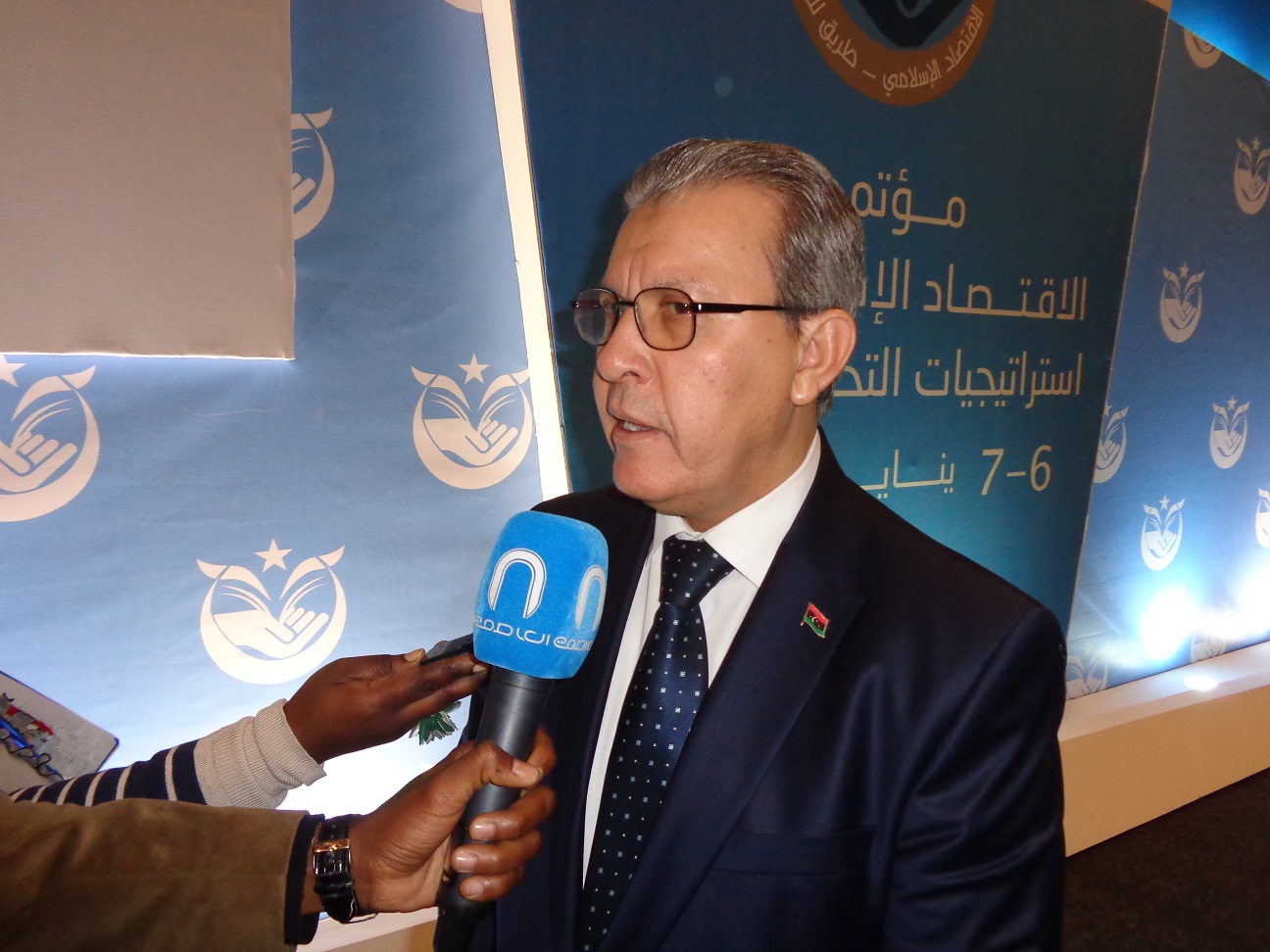
The Minister of Economy Mustafa Abufunas said that the move to an Islamic economy was likely to be gradual (Photo: Sami Zaptia).

By Sami Zaptia.

The Minister of Economy Mustafa Abufunas said that the move to an Islamic economy was likely to be gradual (Photo: Sami Zaptia).

Tripoli, 6 January 2014:

The two-day conference on the Islamic economy, organised by the Ministry of Economy, . . .[restrict]opened today at the Corinthia hotel, Tripoli.

The well attended conference was opened by the host, the Minister of Economy Mustafa Abufunas, and was attended by the Deputy head of the GNC, Salah Makhzoum, Electricity Minister Muherieg, (the Islamist) Justice and Construction Party head Mohamed Sawan as well as leading members of the business community.

In his opening speech, Mustafa Abufunas, Minister of Economy, said that the conference was “part of the  effort to discover Libya’s economic identity as Libya continues its efforts to build its economy and draft its constitution”.

RELATED POSTS

Libya supplied nearly a quarter of Italy’s total crude oil imports in 2025

Zawia Oil Refining Company prepares to establish 100-million litre industrial oils plant in Benghazi‎

“The Libyan economy is divided into two categories”, Abufunas said, “the energy sector is high value but with low employment whilst the rest of the economy was a high employer but returning low value”, he explained.

The Minister implied that Libya needed to create sectors where there is high employment but equally returning high revenue to the nation’s GDP.

Abufunas criticized the former regime for “ignoring most non-oil sectors of the economy such as industry and tourism”. He also lamented the fact that “foreign investors were only interested in investing in Libya’s hydrocarbon sector”.

With the ongoing background of most of Libya’s oil production halted due to the oil blockade of its eastern oil ports, the Economy Minister highlighted the perils of Libya’s over dependence on oil, saying that in 2010 it produced 1.7 million bpd, whilst now this was down to almost nothing.

In fact, last Saturday the Ministry of Oil reported oil production at 286,186 bpd for 4 January.

Libya is a state that simply “distributes its oil wealth to its citizens rather than a productive and creative state. How do we get out of this reality and create a strong productive economy”, the Minister asked rhetorically.

The Minister had no doubts of the role of Islamic economics in the world, referring to a recent Islamic conference in London in which he said the growing role of Islamic banking in the world was highlighted.

Abufunas would not put a timeline on when Libya would become an Islamic economy. He said that this conference was organized to come up with some visions and ideas – including timelines.

However, speaking to the media during the break, Minister Abufunas noted that much like the case for the Islamic banking law introduced recently in Libya, any “transition to an Islamic economy would have to be gradual”.

The GNC Deputy Head Salah Makhzoum said in his opening remarks that there was a link between Libya’s security and its economy. “The activation of Libya’s economy is the solution to Libya’s security. Activating the economy will encourage SMEs and it will encourage foreign investors to return to Libya and participate in Libya’s economic growth”.

The conference will continue for two days with 12 papers on the general characteristics of an Islamic economy, including banking monetary policy, insurance, investment without interest, endowments, SME financing etc.

[/restrict]

Tags: employmentfeaturedGNCIslamic economyminister of economyMinister of ElectricityMustafa AbufunasoilSMEs

Related Posts

Libya France Finance Forum will be held in Paris on 8 June
Business

Libya France Finance Forum will be held in Paris on 8 June

June 7, 2026
Libyan Industrial Union organizing conference on Libyan economy – invites participation
Business

Libyan Industry Union launches “Made in Libya” e-platform following approval by Minister of Economy and Trade

June 7, 2026
AGOCO reactivates stalled old Nafoura well to produce 1,200 bpd
Business

Arabian Gulf Oil Company rehabilitates distressed well at Al-Bayda field at a rate of 1,553 barrels per day‎

June 7, 2026
REAoL makes 500 MW Ghadames solar project site inspection
Business

China’s CHEC Co. confirms interest in Libyan market, readiness to enter effective investment partnerships in renewables with REAoL

June 4, 2026
International Forum for Documentary Credits and Foreign Trade to be held in Tripoli from 6 to 7 July
Business

International Forum for Documentary Credits and Foreign Trade to be held in Tripoli from 6 to 7 July

June 4, 2026
Transport Ministry meets Japanese company North Star interested in investing in Libya
Business

Minister of Transport discusses with Chinese Ambassador benefiting from China’s experience in transportation, resuming direct flights

June 4, 2026
Next Post

Seventy seven year old man and child kidnapped in Benghazi

Total restarts offshore exploration

Total restarts offshore exploration

Top Stories

  • UNHCR: We need more money to help Libyan refugees

    Sentiment growing against illegal refugee settlement, resettlement or naturalisation across Libya – UNHCR singled out for criticism

    0 shares
    Share 0 Tweet 0
  • Central Bank of Libya source to Libya Herald: US$ 3.5 bn plan launched today to cover Letters of Credit, transfers, and personal use

    0 shares
    Share 0 Tweet 0
  • Libya’s recent fuel crisis: A dramatic surge in fuel demand from the usual 6.5 million litres to 9.5 million litres daily: NOC Chairman Suleiman

    0 shares
    Share 0 Tweet 0
  • “No to Settlement, Naturalisation – Libya for Libyans” ‎Movement rallying Libyans to resist settlement of illegal migrants

    0 shares
    Share 0 Tweet 0
  • ‘Refugees in Libya’ condemns campaign of dehumanization against migrants, refugees, and asylum seekers in Libya

    0 shares
    Share 0 Tweet 0
ADVERTISEMENT
LibyaHerald

The Libya Herald first appeared on 17 February 2012 – the first anniversary of the Libyan Revolution. Since then, it has become a favourite go-to source on news about Libya, for many in Libya and around the world, regularly attracting millions of hits.

Recent News

Libya France Finance Forum will be held in Paris on 8 June

Libyan Industry Union launches “Made in Libya” e-platform following approval by Minister of Economy and Trade

Sitemap

  • Why subscribe?
  • Terms & Conditions
  • FAQs
  • Copyright & Intellectual Property Rights
  • Subscribe now

Newsletters

    Be the first to know latest important news & events directly to your inbox.

    Sending ...

    By signing up, I agree to our TOS and Privacy Policy.

    © 2022 LibyaHerald - Powered by Sparx Solutions.

    Welcome Back!

    Login to your account below

    Forgotten Password? Sign Up

    Create New Account!

    Fill the forms below to register

    *By registering into our website, you agree to the Terms & Conditions and Privacy Policy.
    All fields are required. Log In

    Retrieve your password

    Please enter your username or email address to reset your password.

    Log In
    No Result
    View All Result
    • Login
    • Sign Up
    • Libya
    • Business
    • Advertising
    • About us
    • BusinessEye Magazine
    • Letters
    • Features
    • Why subscribe?
    • FAQs
    • Contact

    © 2022 LibyaHerald - Powered by Sparx Solutions.

    This website uses cookies. By continuing to use this website you are giving consent to cookies being used. Visit our Privacy and Cookie Policy.