Samir Alwarfally, the Chairman of the Union for Renewable Energies in Libya (UREL), has continued to call on the Tripoli based Libyan government to support renewable energies to save on import bills, increase food security and oil and gas exports.
Alwarfally studied Solar Energy at Tripoli University and after graduating in the subject and worked for three years at the (Libyan) Centre for Solar Energy Research and Studies (CSERS) based in the Tajura district of Tripoli.
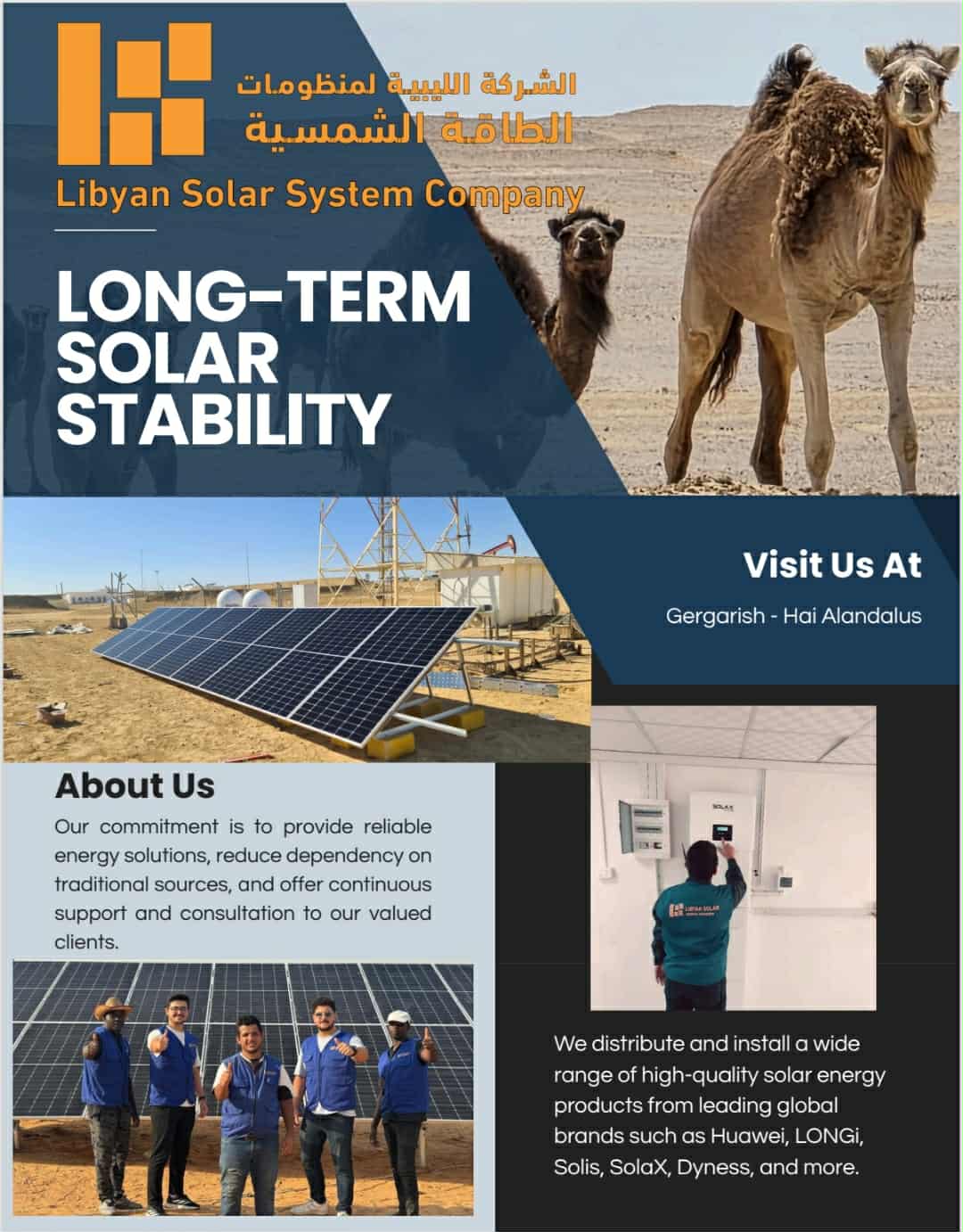
Besides being the head of the UREL, Alwarfally owns a company, the Libyan Solar Systems Company, that instals renewable energy systems, with a current focus on installing solar panel systems.
Speaking exclusively to Libya Herald in his Tripoli office and Libyan Solar Systems Company showroom, Alwarfally said, the installation of solar panel systems would save 40 percent of Libya’s energy use for heat and water.
‘‘Doing so will save 30 percent to 40 percent of electricity demand, and street lighting in Libya also uses another 20% of total demand, yet the government does not use solar lighting on the streets, nor does it help citizens install solar panel systems at home or in their work or farms’’, he complained.
The Libyan Solar Systems Company Ltd
Alwarfally said there are great opportunities for the installation of solar panel systems in Libya and growing opportunities for their use of in the South of Libya for both farmers and other users that may be off grid. His company also sells mobile 2 kw solar panels systems for one-off events, picnics etc that can be packed away and used elsewhere on another occasion.
Solar power systems installed for agricultural use in remote central Libya
Alwarfally said his company has installed several solar panel systems at farms in the remote central Libyan desert areas of Jufra, at Waddan and Sokna. These are located about 650 km southeast of the capital Tripoli.
These solar panel systems are used in these remote areas where it is difficult to get connected to the national grid or where there are frequent power cuts. The solar set up is used to pump water from borewells or rotate the single pivot agricultural systems. On average, he explained, 15 panels will produce 7.5 kw which is what is needed for farms to pump water from wells and other power needs.
Numerous economic and social advantages to installing solar systems
However, Alwarfally bemoaned the fact that the Libyan authorities do not support people to install solar panel systems. If they did, he stressed, there would be an increase in agricultural production and therefore fewer food imports. This would not only save Libya its much in demand hard currency reserves but also help towards the government policy of improving food security.
The win-win results of using solar power systems
It would also mean less consumption of electricity from the grid. That would mean less fuel being used to create electricity and therefore more oil and gas for export to earn more hard currency. It would also encourage Libyans in the non-urban coastal areas to remain in their places of origin and work their land and farms. This would reduce overcrowding in coastal urban areas, create jobs, retain youths locally and diversify the economy.
Demand for change of legislation
Alwarfally said the UREL has asked the government to change the regulations to enable people to install solar panel systems, but it has had no positive answer.
No need for subsidies or grants – just bank loans
The UREL head made it clear that his organisation is not asking the Libyan government to offer subsidies or grants to install solar panels, but rather it wants the authorities to change the regulations so that banks will provide loans to farmers to install them.
He complained that successive Renewable Energy of Libya (REAoL) heads have done nothing to help support private-sector renewable energy companies.
Alwarfally called on the authorities to sit down with the private sector renewable energy companies and hear their ideas.
There are 15 companies in the Libyan Renewable Energy Union REUL
Alwarfally said the main function of REUL is to put pressure on the government to support renewables. He said the REUL is growing and currently has 15 member companies. He said his own company trains no less than 20 renewable energy engineers every month, giving them the first course free.
Libya produces least renewable energy in the world
“Libya leads the list of countries that produced the least amount of renewable energy. At present, renewables account for less than 1% of power generated. According to the Libyan government’s strategy announced in 2023, we should now be at 20%.”
“There are not many solar panels installed in Libya. The high subsidies for fuel disincentivises the use of renewable. They make it seem expensive.
“Successive Libya governments and successive renewable energy organisations have failed to support renewable energy in Libya, both in the public and private sectors.”
A different story in the oil sector
Alwarfally said oil companies, on the other hands, are very eager to adapt and adopt renewable energy to reduce their carbon footprint. He said they have already taken several initiatives.
For example, his company is a “strategic partner” for Huawei’s solar panels. It has also installed seven solar systems for Mabruk Oil Company, a solar lighting system for the Ras Lanuf Oil Company, and several systems for Sirte Oil Company.
In the pipeline, the company is installing a system for Harouge Oil Company and conducting studies with Zallaf Oil Company to operate an oil well which should be installed in January or February 2026.
Both the NOC and oil minister Abdel Sadeg are now taking the idea of solar energy seriously and paying more attention to it, but support from the government is still an impediment, he added. “We are not asking for subsidies. We want banks to provide loans to citizens”, he repeated
All government buildings must install solar panels
Alwarfally did commend the Tripoli government, however, for planning to instal solar panel systems on all government buildings. This came in the form of a directive (No. 219765) this August by the state General Electricity Company of Libya (GECOL).
“We would like to thank the government for this decision. I hope it is a start to encourage the use of solar energy.
Need for incentivising legislation
“There needs to be incentivising legislation from the government. Also there needs to be legislation that will allow GECOL to purchase excess power from those producing power through solar panels. They need to set a (Feed-in) tariffs. We have presented several proposals to the government. If they supported the use of solar panels for water heaters it would save 40 percent of energy. We have attempted to explain this to them and presented proposals to them several times without success’’.
No letters of credit opened for the import of solar panel systems
Furthermore, Alwarfally complained that ‘‘The authorities will still not open letters of credit for the import of solar panel systems’’.
In effect, this means solar panel systems would have to be imported using dollars purchased on the black-market which is at a higher exchange rate than the official exchange rate obtainable through the opening of letters of credit. This makes them even more expensive and less competitive against the use of Libya’s heavily subsidised electricity.
Solar Panel Tariffs
It will be recalled that so-called Feed-in-Tariffs or Solar Panel Tariffs in the UK, for example, refer to the government backed export tariffs under what is now called the Smart Export Guarantee (SEG) scheme. This was previously called the Feed-in-Tariff (FIT) before 2020. This is where energy suppliers pay consumers for electricity exported from their solar panels / small solar farms etc, back to the grid.
Energy suppliers in the UK for example, with a minimum number of consumers, are obliged to buy surplus energy produced by consumers under the tariff set by the government. This acts as a long-term incentive for consumers to install solar systems and produce excess energy which they know there is a guaranteed market for.