No Result
View All Result
Saturday, December 6, 2025
23 °c
Tripoli
24 ° Sat
24 ° Sun
  • Advertising
  • Contact
LibyaHerald
  • Home
  • Libya
  • Business
  • Opinion
  • Magazine
  • Advertising
  • Login
  • Register
SUBSCRIBE
  • Home
  • Libya
  • Business
  • Opinion
  • Magazine
  • Advertising
  • Login
  • Register
No Result
View All Result
LibyaHerald
No Result
View All Result
Home Libya

Libya has urgent governance crisis says new UNSMIL chief

byNigel Ash
August 29, 2017
Reading Time: 3 mins read
A A
Libya has urgent governance crisis says new UNSMIL chief

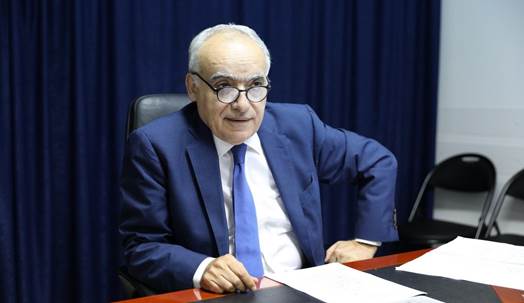
UNSMIL chief Ghassan Salamé (Photo: UNSMIL)

By Libya Herald reporters.
New UNSMIL chief Ghassan Salamé today (Photo: UNSMIL)

Tunis, 28 August 2017:

Libya has a serious problem of governance that can hardly wait to be addressed, the new UNSMIL chief Ghassan Salamé has told the UN Security Council.

In a concise and lucid first report to the UN, during which he made a point of saying he was speaking by videoconference from Tripoli, Salamé said: “The impression of a now well-rooted political economy of predation is palpable, as if the country is fuelling its own crisis with its own resources to the benefit of the few and the frustration of the many”.

He said that from his meetings during his first month in the job a clear picture was emerging.

RELATED POSTS

Following mobilisation of forces around Tripoli, UNSMIL calls for peaceful dialogue and de-escalation: report and analysis

UNSMIL head Tetteh proposed new sequenced Roadmap includes parliamentary and presidential elections and a new unified government

“People are frustrated with their deteriorating living conditions.  I passed the same bank in Tripoli repeatedly from ten o’clock in the morning until ten o’clock at night and saw so many people I thought it was a demonstration.  No! They were just waiting to access a fraction of their month’s salary – the equivalent of what’s now worth $25”.

He continued: “People are tired of the endless cuts in electricity and water, which in turn take down the telephone system and the internet.  Libyans cannot understand being poor in a country rich with natural resources.  An oil producing country where they must queue for sometimes a day to get 20 litres of petrol”.

He said that Libyans to whom he had spoken wanted an end to uncertainty and instability and they respected those who were working towards these ends. Though he insisted that in Tripoli and certain other parts of the country security had “truly improved” he also said that there was widespread fear of criminality, kidnapping and the threats posed by the widespread proliferation of weapons. He noted: “My first night here in Tripoli, I fell asleep to the protracted staccato of gunfire”.

Salamé, with his background in academe, also noted that it was “unnatural” that in a country as wealthy as Libya, university departments should be closing one after another because of the “outrageous gap” in the exchange rate which was causing foreign lecturers to leave en mass.

The new UNSMIL chief said he had been fortunate to be at the Paris Serraj-Hafter meeting brokered by French president Emmanuel Macron before he actually took up his post. Among the other contacts he has since had he included House of Representatives (HoR) president Ageela Saleh, State Council head Abdulrahman Sewehli as well as talks with leaders  in Benghazi, Misrata, Zintan and Beida.

He regretted however that “due to external restrictions I have yet to visit the south. In fact a trip last Thursday was cancelled a few hours before departure, but we are working hard to make sure that it happens as soon as possible”.

Salamé defined the four challenges that he saw. The first was the continued standing of the Libyan Political Agreement (LPA) after its second anniversary this December. “There is uncertainty over what the end of the transitional period outlined in the LPA actually means. One of the most immediate tasks is to help build a consensus among Libyans on the legal and political significance of that date.  An institutional vacuum at this crucial time will not serve Libya’s interests”.

He said that as a result of his talks so far on amendments to the LPA, he believed a consensus was emerging. “I hope to be able to announce some movement on it in the coming days”.

The second challenge was the constitution voted on last month by the Constitution Drafting Assembly  but he added that the legality of this “important milestone” was currently being reviewed by the courts.

In outlining the third challenge, fresh elections, Salamé did not address specifically how the required referendum on the new constitution might fit around a general election.  However, he did say that, before what he described as the growing and widespread calls for fresh elections could take place, it would be wise to ensure political and technical preconditions for success  were addressed.  In particular, there needed to be a commitment by all parties to accept the results. Elections, he said, were not about the accumulation of power but about its peaceful and organised rotation.

The fourth challenge, he outlined was to construct the political package that would bring the amended LPA, the constitution and the general election together.

“ Here, sequencing is the name of the game” he said, “Libyans can successfully go into these three processes only if they define in what order and with what urgency they should do so, and if we help them combine the three into one single package which most, if not all, players consider acceptable”.

Repeating the mantra of his two immediate predecessors, Bernadino Leon and Martin Kobler, Salamé insisted that any efforts to forge the solution had to be Libya-led and Libyan-owned.

“The United Nations is here to support Libyans in their endeavours, and certainly not to replace them” he said,  “We will in particular work with them to promote the rapid re-unification of their political and financial institutions”.
Tags: featuredGhassan SalaméLibyaSecurity CouncilUNSMIL

Related Posts

CBL receives results from meetings with international banks
Business

Latest CBL stats to November 2025 show significant growth in Libya’s electronic banking sector

December 6, 2025
Nine deaths and 16 injured in Tajura state-recognised militia clashes
Libya

Overnight Zawia clashes end with civilian injuries and unconfirmed deaths

December 5, 2025
Interior Ministry’s Diplomatic Missions Protection personnel receiving training in Ukraine
Libya

Three million illegal immigrants in Libya, 75 % of whom are families, constitute ”settlement” which Libyans reject – illegally transfer US$ 7 billion annually: Interior Minister Trabelsi

December 4, 2025
EU to end Operation Sophia and to launch new Mediterranean operation to monitor UN Libya arms embargo
Libya

EU concludes Rome consultations with Libyan institutions on new migration and border management programme

December 4, 2025
Interior Ministry’s Diplomatic Missions Protection personnel receiving training in Ukraine
Libya

Libya’s National Programme for the Deportation of Illegal Immigrants: thousands repatriated with aim to repatriate 60,000 per month

December 3, 2025
ICC upholds admissibility of Saif Qaddafi’s trial
Libya

Libyan national Khaled El Hishri wanted for crimes against humanity and war crimes surrendered by Germany to the custody of the International Criminal Court  

December 2, 2025
Next Post

Bunyan Marsous and LNA reinforce armies around Sirte

Oil output disruption has cost Libyans $160 billion in just three years says CBL

libyaherald-Ads

Top Stories

  • Former Tripoli Marriot hotel rebranded, upgraded and reopened as Al-Hayat Tower

    Former Tripoli Marriot hotel rebranded, upgraded and reopened as Al-Hayat Tower

    0 shares
    Share 0 Tweet 0
  • AmCham Libya organizing Second AmCham Pavilion at Tripoli’s 2026 Libya Energy & Economic Summit (LEES)

    0 shares
    Share 0 Tweet 0
  • Libyan Ministry of Oil and Gas and Algeria’s Sonatrach discuss enhancing cooperation in the sector

    0 shares
    Share 0 Tweet 0
  • Libya needs over one million housing units over next 10 years costing over 200 billion dinars

    0 shares
    Share 0 Tweet 0
  • Three million illegal immigrants in Libya, 75 % of whom are families, constitute ”settlement” which Libyans reject – illegally transfer US$ 7 billion annually: Interior Minister Trabelsi

    0 shares
    Share 0 Tweet 0
ADVERTISEMENT
LibyaHerald

The Libya Herald first appeared on 17 February 2012 – the first anniversary of the Libyan Revolution. Since then, it has become a favourite go-to source on news about Libya, for many in Libya and around the world, regularly attracting millions of hits.

Recent News

Zueitina Oil and Gas Co. launches Second Injection Unit – increasing production by 8,000 barrels per day

Latest CBL stats to November 2025 show significant growth in Libya’s electronic banking sector

Sitemap

  • Why subscribe?
  • Terms & Conditions
  • FAQs
  • Copyright & Intellectual Property Rights
  • Subscribe now

Newsletters

    Be the first to know latest important news & events directly to your inbox.

    Sending ...

    By signing up, I agree to our TOS and Privacy Policy.

    © 2022 LibyaHerald - Powered by Sparx Solutions.

    Welcome Back!

    Login to your account below

    Forgotten Password? Sign Up

    Create New Account!

    Fill the forms below to register

    *By registering into our website, you agree to the Terms & Conditions and Privacy Policy.
    All fields are required. Log In

    Retrieve your password

    Please enter your username or email address to reset your password.

    Log In
    No Result
    View All Result
    • Login
    • Sign Up
    • Libya
    • Business
    • Advertising
    • About us
    • BusinessEye Magazine
    • Letters
    • Features
    • Why subscribe?
    • FAQs
    • Contact

    © 2022 LibyaHerald - Powered by Sparx Solutions.

    This website uses cookies. By continuing to use this website you are giving consent to cookies being used. Visit our Privacy and Cookie Policy.