By Sami Zaptia.
London, 15 June 2015:
On the 800th anniversary of the signing . . .[restrict](sealing) of the Magna Carta (Grand Charter) limiting the arbitrary powers of a supreme English monarch by his rebel barons, some Libyans cannot help but wonder as to its relevance in the post-Qaddafi semi-democratic era of today.
There is no doubt that there are varying interpretations and readings and that there is much debate and discussion on the relevance of the 15 June 1215 Magna Carta in today’s world.
At the time, the Charter represented an internal power struggle between the god ordained monarch and his rich land-owning barons. It was about limiting and setting a framework for that relationship as opposed to offering a universal franchise for all English classes.
However, as one of the most cited documents when it comes to basic human rights, liberties and freedoms, it has become a mythical something for everyone, and has become much more than it was probably intended to be at the time.
It has become the venerated historical document alluded to as the symbol of liberty wherever liberty, freedom and rights are being challenged by arbitrary power. It is credited with inspiring the US Constitution and the Universal Declaration of Human Rights.
Its importance viz-a-viz arbitrary power, arbitrary arrest, imprisonment without trial, the rule of law, taxation without representation, accountability to the people and the whole challenge to democracy and liberty makes the Magna Carta still very much relevant in today’s world.
In the initial years and centuries after its signing, the Magna Carta was renewed by succeeding English monarchs as a form of the land’s unwritten constitution or a social contract.
In today’s Libya, the struggle to uphold or establish beyond question in practice the principle of the rule of law is still an ongoing battle. There is rarely a month that passes that there is no report of Libyans and foreigners being arrested, detained or kidnapped.
Only these last two weeks bank employees, foreign diplomats and charity workers were kidnapped by militias operating outside the control of the weak and split state. There can be no enjoyment of freedom and liberty and democracy without security and a strong state.
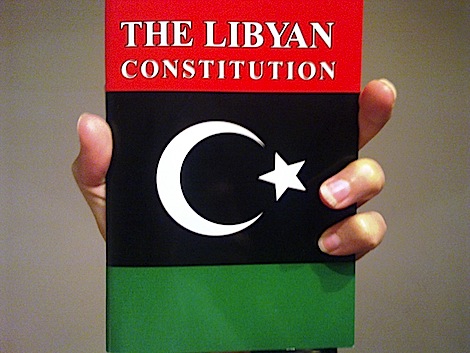
Libya has set off on the road to drafting its new constitution that is intended to set and define the relationship between the rulers and ruled and establish the rules and process for peaceful, democratic alternation of government. The political and military conflict and resultant de facto split of the country has stalled this fundamentally important process.
Meanwhile, Libya has continued, or has attempted to continue, to operate politically under the auspices of its temporary social contract, the Transitional Constitutional Declaration (TCD) of August 2011.
That document announced by the National Transitional Council (NTC) to the Libyan people as a promise and political roadmap, has stuttered and ultimately collapsed in July 2014 when militias invaded Tripoli in a coup d’état against the newly democratically elected parliament.
The newly elected parliament and its subsequent government was forced to flee the capital Tripoli and set up in exile in the eastern cities of Tobruk and Al-Beida.
But as we see from English and British history, for although the Magna Carta was agreed to in 1215, many of its basic principles were not enshrined into British law until the 1900’s.
The Magna Carta suffered many reverses during its lifetime including being reneged upon by its signatories, King John and the rebelling barons. Nevertheless, once the idea of the contents of the Magna Carta had been established in the psyche of initially the baron class, and in later centuries, the people in general, it became a persistent demand across the world.
The genie was out of the lamp and there was no way of suppressing the ideas and ideals that the Magna Carta actually proposed or inspired. It became difficult for subsequent monarchs of England and their succeeding British monarchs to resist relentless demands for political reform and representation. Ultimately this led to the unchallenged principle of ‘’no taxation without political representation’’.
In Libya’s case, the principle of democracy was established in article 1 of the TCD which states that the people act as the source of political authorities and article 4 declares the aim of establishing a democratic state based on a multi-party system.
The principle of the rule of law is established in article 6, adding that it takes precedence over tribal or personal loyalties and establishes the principle of non-discrimination and equal rights of all citizens regardless of religion, ethnicity or social status. It also guarantees the state upholding women’s rights granting them full participation in politics, economy and society in general.
While the precedent set by the 2011 TCD and the 2012 and 2014 parliamentary elections, as well as the Constitutional Drafting Assembly elections, pale into insignificance when compared to English/British political history of the Magna Carta dating back 800 years, it nevertheless has set a precedent and a reference point for Libyan democrats and liberals .
After 42 years of Qaddafi era dictatorship Libyans have no desire in reverting to sultanistic, totalitarian, arbitrary, personal, family and tribal rule.
Libyans aspire to a constitution that guarantees the peaceful transition of government with transparency, accountability, the rule of law, justice and liberty. Libyans do not aspire to unaccountable rulers that squander their hydrocarbon wealth or act as if they are above the law.
They aspire to a new democratic nation where its presidents, prime ministers, ministers, members of parliament and members of its armed forces are all subject to the rule of law. They aspire to a strong state and strong state institutions where the state enjoys a monopoly over the use of legal force. They do not want a nation run by militias who act above the law. They want limits to executive powers and limits to the arbitrary use of force.
They want a responsible accountable parliament and government that represents the interests of the nation and of all the people – chosen by all the people.
This means men and women, westerners, easterners and southerners. It means Libyans across all its four corners and made up of its varying Arab, Tuaregs, Tebu and Amaziegh peoples who want to enjoy their freedoms of expression, liberties and cultures guaranteed by the law of the land. They want to be treated equal and have their rights protected.
We often hear of the ‘’values of the 17 February 2011 revolution’’ and how this or that militia group, town, city or region are acting in the interest and in protection of the values of the 17 February revolution.
The values of the 17 February revolution – the values for which the overwhelming majority of Libyan civilians rose against the Qaddafi dictatorship in 2011 – are all set in stone in the TCD, and need no armed militia group to unilaterally protect them. They stand for democracy in all its liberal, consensual, inclusive, participatory, representative meaning.
Together with the amended constitution of the Kingdom era of Libya, the TCD acts as Libya’s modern-day Magna Carta. It is embedded in the history and psyche of modern day Libyan democrats and, as was the case in the history of England, despite dictatorial interruptions, is still the only serious political roadmap being considered today.
Libyans await patiently as their warring politicians jostle to uphold and execute the only social contract in town – that promised by the TCD of a fully democratic modern state. The rest of the democratic world waited centuries to implement the principles of Magna Carta. Libyans hope that they do not have to wait 800 years.
But if they are forced to wait for a democratic state to be established, they know ultimately democracy, rather than dictatorship is worth waiting for. [/restrict]