No Result
View All Result
Tuesday, December 16, 2025
23 °c
Tripoli
24 ° Sat
24 ° Sun
  • Advertising
  • Contact
LibyaHerald
  • Home
  • Libya
  • Business
  • Opinion
  • Magazine
  • Advertising
  • Login
  • Register
SUBSCRIBE
  • Home
  • Libya
  • Business
  • Opinion
  • Magazine
  • Advertising
  • Login
  • Register
No Result
View All Result
LibyaHerald
No Result
View All Result
Home Libya

Libya’s continuing war economy is making a functioning state less likely: report

bySami Zaptia
April 12, 2018
Reading Time: 2 mins read
A A
Libya’s continuing war economy is making a functioning state less likely: report

By Sami Zaptia.

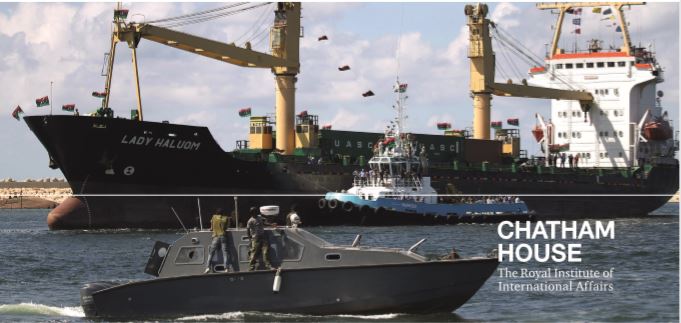
196-Chatham House report on Libyas war economy-120418
Libya’s continuing war economy is making a functioning state less likely a Chatham House report says (Photo: Chatham House).

London, 12 April 2018:

As Libya’s war economy persists, prospects for the restoration of functioning central governance become more distant, concluded a Chatham House report published today.

The 38-page report ‘‘Libya’s War Economy: Predation, Profiteering and State Weakness’’ authored by Tim Eaton, says that Libya suffers from interlinked political, security and economic crises that are weakening state institutions, damaging its economy and facilitating the continued existence of non-state armed groups.

As rival authorities continue to compete for power, the resulting fragmentation and dysfunction have provided a fertile environment for the development of a pervasive war economy dependent on violence, the report adds.

RELATED POSTS

Tripoli government confirms three track security policy: supporting regular army, ending gangs and armed outlaw groups and maintaining stability

Mouta’alleq 3 Project holds Job Fair for ex-militias

This war economy is dynamic and constantly in flux. Relative to earlier problems, there were signs of progress on several fronts in 2017: a reduction in human smuggling, a tripling in oil revenues, and increased local action against fuel smuggling. Yet the dynamics that have supported the war economy’s rise remain.

The report said that Libya’s war economy is highly damaging for the future of the state for three reasons:

First, it provides an enabling environment for networks of armed groups, criminal networks, corrupt businessmen and political elites to sustain their activities through illicit sales and predatory practices. Their operations are closely linked to the dispensation of violence, and are thus a spur for further conflict.

Second, the war economy perpetuates negative incentives for those who profit from the state’s dysfunction. Only effective governance, supported by a durable political settlement, can tackle the foundations of Libya’s war economy. But neither a return to functioning central governance nor the development of a security sector that is fit for purpose is in the interests of war economy profiteers, who are therefore motivated to act as powerful spoilers of reform.

Third, the political contestation and resource predation practised by those engaged in the war economy are having a disastrous impact on Libya’s formal economy, undermining what remains of its institutions. As the war economy persists, therefore, the prospects for the restoration of functioning central governance become more distant. This threatens to create a vicious cycle that accelerates further state collapse.

Due to the limited capacity for coercion available to any actor or entity connected with the state, a strategy of co-opting networks of war economy profiteers has almost exclusively prevailed. This has failed. Drawing on the lessons from these attempts, a more successful policy must pursue targeted measures to combat the enabling structures of Libya’s war economy where possible, and to co-opt war economy profiteers only where necessary.

In this, state authorities can do more to utilize what power they have to name and shame war economy profiteers in order to weaken the local legitimacy critical to profiteers’ survival. The state must present credible alternative livelihood opportunities to those engaged in, or benefiting from, the war economy. Progress will depend in part on the creation of positive incentives to abandon such activity. Where profiteers cannot be incentivized to move towards more legitimate economic activities, greater and more effective efforts must be made to reduce the profit margins of illicit schemes.

The international community can do more to support Libyan efforts in countering the war economy. Cooperation over the targeting of criminal groups’ overseas assets, support for increased transparency over the dispensation of state funds, and measures to reduce the viability of illicit activities can all help to strengthen the position of state authorities, the report concluded.


Tags: featuredmilitiassmuggling. predationwar economy

Related Posts

Attorney General orders arrests at Jumhouria bank branch for embezzlement
Libya

Former financial controller at the Libyan mission to the Vatican City State to be detained for misappropriation of € 646,249 meant for treating war wounded

December 15, 2025
Wanted criminal militiaman Ahmed Omar Al-Fetouri Al-Dabashi, nicknamed “Al-Amu,” killed in counter security operation
Libya

Wanted criminal militiaman Ahmed Omar Al-Fetouri Al-Dabashi, nicknamed “Al-Amu,” killed in counter security operation

December 14, 2025
REAoL makes 500 MW Ghadames solar project site inspection
Business

REAoL holds meeting with EU Commission – support in technical consultations, studies, training and qualification of specialized cadres offered

December 13, 2025
ACA reveals 94,000 cases of state sector salary duplication in 2015
Libya

“Building Libyan National Capacities in the Fields of Combating Corruption and Money Laundering 2025–2027” agreement signed between ACA and UNSMIL at Anti-Corruption event

December 10, 2025
CBL Governor Issa announces three strategic initiatives to build a stronger banking sector at 6th Banking Sector Development Forum in Tunis 7 to 9 December
Business

CBL Governor Issa announces three strategic initiatives to build a stronger banking sector at 6th Banking Sector Development Forum in Tunis 7 to 9 December

December 7, 2025
CBL receives results from meetings with international banks
Business

Latest CBL stats to November 2025 show significant growth in Libya’s electronic banking sector

December 6, 2025
Next Post
HoR head Saleh accepts HSC head Mishri’s invitation to meet

HoR head Saleh accepts HSC head Mishri’s invitation to meet

HoR head Saleh says he is in contact with Hafter and warns against rumours and incitement – fails to allay rumours

HoR head Saleh says he is in contact with Hafter and warns against rumours and incitement – fails to allay rumours

libyaherald-Ads

Top Stories

  • NOC announces force majeure at Zawia port

    BP celebrates the reopening of its Tripoli office: NOC

    0 shares
    Share 0 Tweet 0
  • U.S. company Farm Tech meets NDA in Benghazi to discuss 1,000 pivot irrigation project to bolster Libya’s food security

    0 shares
    Share 0 Tweet 0
  • Libyan banks cannot give loans without proper collateral and regulations that allow for recourse in case of default: Tadawul Tech Chairman Naaman Elbouri

    0 shares
    Share 0 Tweet 0
  • Austria’s OMV prepares to lift force majeure and resume its exploration commitments in Libya

    0 shares
    Share 0 Tweet 0
  • Tripoli government meets World Bank delegation – government’s vision for economic and financial recovery and improving Libya’s “Business Readiness” index discussed

    0 shares
    Share 0 Tweet 0
ADVERTISEMENT
LibyaHerald

The Libya Herald first appeared on 17 February 2012 – the first anniversary of the Libyan Revolution. Since then, it has become a favourite go-to source on news about Libya, for many in Libya and around the world, regularly attracting millions of hits.

Recent News

African Development Bank adopts new cooperation strategy with Libya for 2025–28 to support economic recovery, reconstruction, and diversification

Akakus Oil successfully drills and commissions well A-46 with a production capacity of 3,750 barrels per day

Sitemap

  • Why subscribe?
  • Terms & Conditions
  • FAQs
  • Copyright & Intellectual Property Rights
  • Subscribe now

Newsletters

    Be the first to know latest important news & events directly to your inbox.

    Sending ...

    By signing up, I agree to our TOS and Privacy Policy.

    © 2022 LibyaHerald - Powered by Sparx Solutions.

    Welcome Back!

    Login to your account below

    Forgotten Password? Sign Up

    Create New Account!

    Fill the forms below to register

    *By registering into our website, you agree to the Terms & Conditions and Privacy Policy.
    All fields are required. Log In

    Retrieve your password

    Please enter your username or email address to reset your password.

    Log In
    No Result
    View All Result
    • Login
    • Sign Up
    • Libya
    • Business
    • Advertising
    • About us
    • BusinessEye Magazine
    • Letters
    • Features
    • Why subscribe?
    • FAQs
    • Contact

    © 2022 LibyaHerald - Powered by Sparx Solutions.

    This website uses cookies. By continuing to use this website you are giving consent to cookies being used. Visit our Privacy and Cookie Policy.