No Result
View All Result
Monday, March 16, 2026
23 °c
Tripoli
24 ° Sat
24 ° Sun
  • Advertising
  • Contact
LibyaHerald
  • Home
  • Libya
  • Business
  • Opinion
  • Magazine
  • Advertising
  • Login
  • Register
SUBSCRIBE
  • Home
  • Libya
  • Business
  • Opinion
  • Magazine
  • Advertising
  • Login
  • Register
No Result
View All Result
LibyaHerald
No Result
View All Result
Home Libya

Libyan Women and the Informal Market

bySami Zaptia
October 10, 2017
Reading Time: 3 mins read
A A
Libyan Women and the Informal Market

(Photo: Jusoor).

By: Jusoor Centre for Studies and Development.

(Photo: Jusoor).
(Photo: Jusoor).

Tripoli, 10 October 2017:

On October 8th and 9th 2017, the Egyptian capital hosted the launch of the Women’s Economic Empowerment Forum (WEEF) by MENA-OECD Competitiveness Programme which aims at increasing women’s economic potential and participation to build more inclusive and prosperous societies. The launch event brought together high-level policy makers and representatives from business, academia and civil society in the MENA region to exchange experiences and advance concrete actions for policy reform.

The Co-Founder of Jusoor Centre for Studies and Development (Jusoor), Ekram El-Huni, was invited to participate as a speaker on the panel of discussion to give insights on the status of Libyan women and the informal market. Jusoor’s intervention was based on a research paper they published in April 2017. The paper ‘Building an Inclusive Economy in Libya.’ was part of a larger campaign that focused on the inclusion of women in the Libyan formal economy. The research paper took a look at the specificities of Libyan women’s participation in the informal economy through 1. Review of secondary data and 2. Focus Group Discussions carried out with female business owners in Tripoli, Benghazi, Yefren, and Sebha.

According to the IMF – estimates of the size of the informal economy range from 35-44% of GDP in developing countries, to 21-30% in countries in economic transition, and 14-16% in OECD countries. In the case of Libya, 2.6% of the GDP of non-oil commercial activities in the early 1980s, 4.8% in 1989, 8.3% in 1999, but then this decreased to 3.1% in 2006. After 2006, there was a struggle to obtain reliable data on the informal economy with some sources highlighting it would likely have reached 40% by now, particularly considering the effects of war and civil conflict on the shadow economy.

RELATED POSTS

Aldabaiba proposes new Road Map for holding elections, loans and land for youth and money for healthcare for war wounded

Cooperation agreements reached between Libyan and the Greek pharmaceutical and medical companies: Tripoli Chamber of Commerce

The other issue for Libya is that its private sector development has been hampered during the past decades as shown below:


192-Jusoor Cairo conf-2-101017


In terms of women’s contribution to the economy, it’s known that the issues mentioned in the previous section definitely affected their contribution to the economy. The reform measure of the 1990s helped women participate more actively in the private sector (mainly in private schools). However, most of the activities highlighted were home-based and unofficial – including work in fashion design (sewing, tailoring), catering and event management, personal importation of fashion goods for sale (clothes, shoes and beauty products), salons and bakeries/pastry shops.
 

192-Jusoor Cairo conf-3-101017


After 2011, women’s initiatives grew but they remained small in scale and basically informal micro-businesses. While they contribute quite extensively in reducing poverty, and create local and national economic development during this current conflict period, their role is not included in the official economic indicators. Also, women-led projects have a slimmer chance to grow and expand, although they have a considerable market share of the shadow economy and the potential to create jobs and support other businesses in their supply chains.

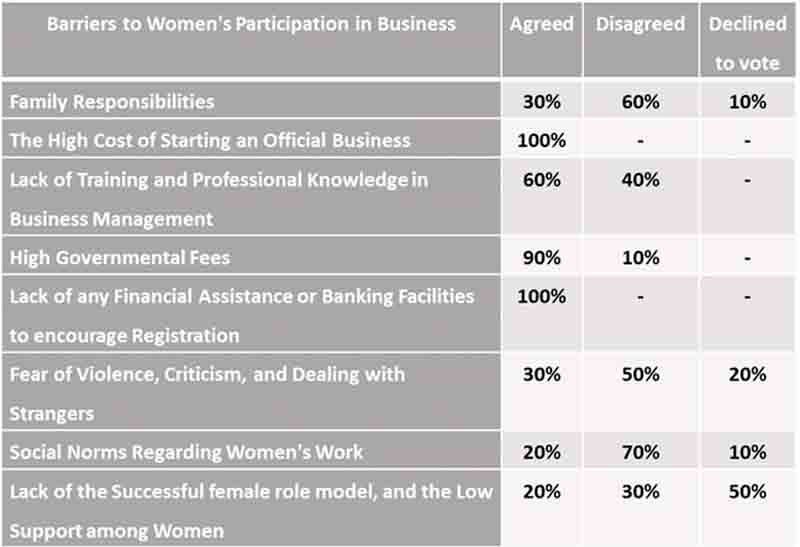
During the discussions with female business owners in Tripoli, Benghazi, Yefren, and Sebha, it was found that the main impediments for Libyan women working in Libya:
 

192-Jusoor Cairo conf-4-101017


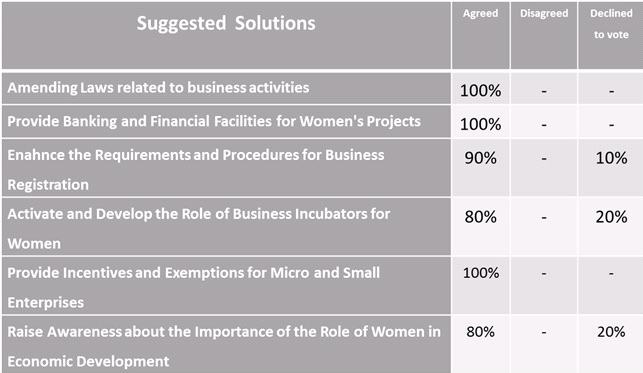
When they were asked about the potential solutions they provided the following suggestions themed around (1) legislation, (2) access to financing and (3) technical support to small and medium enterprises (SMEs):
 

192-Jusoor Cairo conf-5-101017


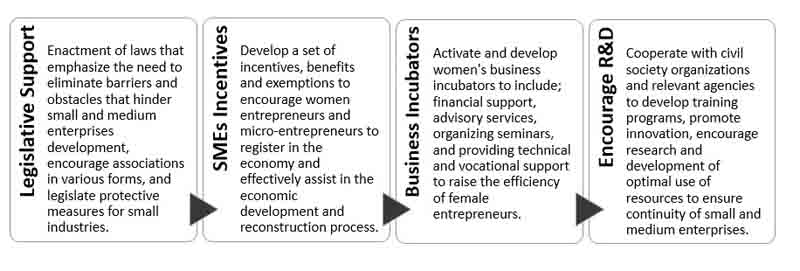
The report has concluded that the social and cultural factors are not the primary reasons that hinders women inclusion in the economic activities but rather the business ecosystem that needs a serious reform to foster stability and long-term growth for small and medium business with the following broad recommendations that will encourage Libyan women to join the formal economy:

There is no doubt that women in Libya have an important role to play in post-revolutionary and during the times of armed conflicts, even though their role is difficult to measure due to the lack of official government statistics or any other reliable sources of data on the participation rates of women and men in the labour force and commercial activities. Jusoor Center is fully committed to continue in advancing women as key partners in the economic development process in different fields including agriculture, industry and services.


The above was a summary of the contribution of Jusoor at the OECD-MENA Women’s Economic Empowerment Forum (WEEF) held in Cairo. Jusoor is a Libyan NGO committed to independent policy research on human development projects for women with focus on economic and social empowerment.

Tags: Ekram El-Huni Jusoor women NGOfeatured

Related Posts

Libya Development and Reconstruction Fund signs contract with Turkey’s Ankamenia for maintenance of Benghazi University’s medical colleges
Libya

Hafters vow to continue uncontrolled public spending – refuse to cut spending to save Libya’s economy – veiled threat to cut off oil supplies

March 15, 2026
Mellitah Oil and Gas launches its tree planting campaign at El-Feel oil field
Libya

Mellitah Oil and Gas launches its tree planting campaign at El-Feel oil field

March 14, 2026
ACA reveals 94,000 cases of state sector salary duplication in 2015
Libya

ACA continues to receive reports of abuse and corruption in public entities from whistleblowers on its Raqeeb website – reaffirms guarantee to protect informants’ identity

March 14, 2026
ACA reveals 94,000 cases of state sector salary duplication in 2015
Libya

Special Flights Authority former official sentenced to five years imprisonment and US$ 13 million fine for Antonov engines corruption

March 13, 2026
HoR condemns Serraj’s foreign intervention call
Libya

HoR Speaker Saleh cancels new import tax having previously claimed he had never agreed such a tax. Is Saleh’s position weakening? Report and analysis

March 13, 2026
HSC confirms conditional attendance of Paris conference
Libya

HSC‘s National Accord Bloc calls on relevant authorities to act against the ”corrupt and illegal” Arkenu Oil Company

March 13, 2026
Next Post

Six Libyan journalists released by the LNA in south

German ambassador meets Serraj, then Hafter

German ambassador meets Serraj, then Hafter

Top Stories

  • Op-Ed: Boulos entrenches Libya’s “flawed reality” and absence of a European role opens door to paths that deepen crisis

    Op-Ed: Boulos entrenches Libya’s “flawed reality” and absence of a European role opens door to paths that deepen crisis

    0 shares
    Share 0 Tweet 0
  • Aldabaiba reveals his new ministerial appointments – top posts of Interior, Oil and Gas, Foreign Affairs and Defence remain unchanged: Report and analysis

    0 shares
    Share 0 Tweet 0
  • Tripoli government team holds further meeting with Boeing regarding the establishment of a new airliner

    0 shares
    Share 0 Tweet 0
  • CBL allows official foreign residents in Libya the use of e-Wallets – sets daily transfer categories

    0 shares
    Share 0 Tweet 0
  • Hafters vow to continue uncontrolled public spending – refuse to cut spending to save Libya’s economy – veiled threat to cut off oil supplies

    0 shares
    Share 0 Tweet 0
ADVERTISEMENT
LibyaHerald

The Libya Herald first appeared on 17 February 2012 – the first anniversary of the Libyan Revolution. Since then, it has become a favourite go-to source on news about Libya, for many in Libya and around the world, regularly attracting millions of hits.

Recent News

ATIB bank signs MoU with Majaal and Xtreme companies to finance and empower micro-entrepreneurs and enhance their growth and sustainability

Ministry of Oil and Gas to launch the Libya Energy Innovation and Research Award

Sitemap

  • Why subscribe?
  • Terms & Conditions
  • FAQs
  • Copyright & Intellectual Property Rights
  • Subscribe now

Newsletters

    Be the first to know latest important news & events directly to your inbox.

    Sending ...

    By signing up, I agree to our TOS and Privacy Policy.

    © 2022 LibyaHerald - Powered by Sparx Solutions.

    Welcome Back!

    Login to your account below

    Forgotten Password? Sign Up

    Create New Account!

    Fill the forms below to register

    *By registering into our website, you agree to the Terms & Conditions and Privacy Policy.
    All fields are required. Log In

    Retrieve your password

    Please enter your username or email address to reset your password.

    Log In
    No Result
    View All Result
    • Login
    • Sign Up
    • Libya
    • Business
    • Advertising
    • About us
    • BusinessEye Magazine
    • Letters
    • Features
    • Why subscribe?
    • FAQs
    • Contact

    © 2022 LibyaHerald - Powered by Sparx Solutions.

    This website uses cookies. By continuing to use this website you are giving consent to cookies being used. Visit our Privacy and Cookie Policy.