No Result
View All Result
Thursday, January 29, 2026
23 °c
Tripoli
24 ° Sat
24 ° Sun
  • Advertising
  • Contact
LibyaHerald
  • Home
  • Libya
  • Business
  • Opinion
  • Magazine
  • Advertising
  • Login
  • Register
SUBSCRIBE
  • Home
  • Libya
  • Business
  • Opinion
  • Magazine
  • Advertising
  • Login
  • Register
No Result
View All Result
LibyaHerald
No Result
View All Result
Home Business

Libya’s political division is root cause of its economic crisis: Audit Bureau 2016 report

bySami Zaptia
May 2, 2017
Reading Time: 3 mins read
A A

By Sami Zaptia.

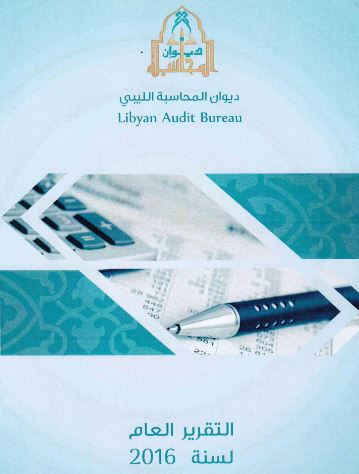
The Tripoli-based Audit Bureau says in its 2016 Annual Report that 2016 was the worse year for Libya (Photo: Tripoli Audit Bureau).
The Tripoli-based Audit Bureau says in its 2016 Annual Report that Libya’s political division is the root cause of its economic problems (Photo: Tripoli Audit Bureau).

London, 2 May 2017:

The underlying cause of Libya’s economic problems in 2016 were caused by the political division of the country. This division had led to the existence of multiple contending governments and central banks – and contending monetary policies.

The assessment was made by the Tripoli-based Audit Bureau in its 623-page 2016 Annual Report released on 26 April.

Reviewing the 2006 ‘’budget’’, the Audit Bureau noted that the sources of the 2016 effective budget and state spending (unapproved by Libya’s legislature the House of Representatives in Tobruk) was 30 percent or LD 8.8 bn from oil, tax, telecoms and fuel sales revenues. The balance of LD 26.6 bn, the70 percent deficit of LD 21 bn, was made up through a Central Bank of Libya (CBL) loan.

RELATED POSTS

CBL’s role in granting LCs is limited – does not include assessing Libya’s economic needs

e-payment transactions for 2025 increased by 186 percent to LD 389 billion: CBL

The Audit Bureau noted that oil revenues in 2016 decreased by 90 percent of normal contributions and fell to a 23 percent contribution to the 2016 effective budget. This contrasts to oil revenue contributions 95 percent of normal budgets historically. The huge fall in tax and customs revenue contributions, indicates poor efficiency by those departments, the Audit Bureau commented.

The Audit Bureau attributed the failure of Libya’s economy mainly to the ‘‘political division’’ between west and east Libya. This division had led to ‘‘multiple governments’’ (the House of Representatives (HoR) recognized Interim Government in Beida, Salvation Government in Tripoli and the only internationally recognized Government of National Accord (GNA) and ‘‘multiple monetary authorities’’ (the internationally recognized Central Bank of Libya in Tripoli and its HoR recognized contender in Beida) has led to the failure in finding solutions to the country’s economic and monetary problems.

It pointed out that the two CBLs were more interested in ‘‘pleasing the authorities they deal with..at the expense’’ of citizens and Libya.

These underlining causes of the country’s economic problems were compounded by the port closures restricting oil production and state oil revenues, rampant corruption by individuals, entities and banks and the lack of security in the country.

The Audit Bureau noted that the belief by Libyan citizens in 2016 that the situation in Libya will not improve soon had led to a loss of confidence and to the hoarding of money. This in turn led to the country’s liquidity crisis and bank queues.

The pumping of more cash into the economy by both banks has led to increased demand for foreign currency for overseas spending/transfers and hoarding – due to the lack of confidence in the Libyan dinar. This resulted in increase of the dollar black market exchange rate against the dinar. The CBL has been unable to meet the demand for hard currency by the Libyan market. The huge rise in the black market exchange rate of the US dollar and insufficient supply to meet demand has had the knock-on effect of inflation and price rises in goods in the domestic market.

The solutions to Libya’s acute economic and monetary problems, the Audit Bureau states, are one unified Libyan government so as to enable the implementation of exceptional policies needed in this period. Libya also needs one CBL implementing unified monetary policies.

Libya also needs to increase its oil production to previous levels and to put in pace spending cuts by the state, including reducing credit and loans, so as to decrease money supply. The authorities also need to put in place incentives to encourage citizens to deposit cash in banks. This could be through the withdrawal of old bank notes in circulation, the temporary devaluation of the dinar or incentives for deposits (Note banks are not allowed to charge or pay interest which is deemed in violation to Islamic Sharia law).

The Audit Bureau also suggested the further encouragement of the use of debit cards, POS and other types of electronic payments methods. It also suggested the supply foreign exchange in an organized and balanced manner. Currently, the widely held Libyan public perception is that foreign currency distribution is monopolized by a few black market traders who are corruptly in league with some bank employees.

However, the Audit Bureau says that if Libya’s political division continues, no policies or reforms or exceptional measures will succeed in solving Libya’s economic problems. It gives the example of the Beida-based Interim Government’s decision of printing LD 4 bn in new bank notes in Russia and its borrowing of LD 12 bn from commercial banks as a case in point.

The continuation in printing and circulating new money notes without withdrawing old notes due to the political division of the country will lead to an increase in Libya’s economic crisis, the Audit Bureau added. Neither of the two contending CBLs can impose any of its monetary policies as neither has control over all of the bank branches across the country – due to the political division.

Tags: Audit Bureau Annual Report 2015budgetCBL Central Bank of Libyadeficitdollareconomyfeaturedforeign exchangemonetaryoil

Related Posts

Libyan Industrial Union organizing conference on Libyan economy – invites participation
Business

The Libyan Industry Union’s Second Annual Forum 2026 is held in Tripoli under the banner: “We Meet to Compete”

January 29, 2026
Harouge Oil reaches record 45,000 bpd production – to increase it by 25,000 bpd
Business

Harouge Oil Operations brings new well B120 at Amal field online with 1,800 bpd

January 29, 2026
Almadar Mobile launches Libya’s first 5G service in Tripoli – countrywide roll out to follow soon
Business

Almadar Mobile launches Libya’s first 5G service in Tripoli – countrywide roll out to follow soon

January 29, 2026
Zallaf Oil Co. ready for implementation phase of Southern Refinery Project – site to be operational soon
Business

KBR to sign technical support and project management contract in February for Libya’s South Refinery

January 29, 2026
PM Aldabaiba inaugurates LEES 2026: Agreements and MoUs signed with Total Energies, ConocoPhillips, Chevron and Egyptian government
Business

Libya to drill between 70-100 new wells in 2026: Libya’s Acting Oil and Gas Minister Abdel Sadig

January 29, 2026
LAIP delegation visits Maputo, Mozambique to recover seized rice project
Business

LAIP signs MoU with Saudi Ajyal Company – discussions included participation in Zuwara Oil Refinery project

January 28, 2026
Next Post

Benina Airport set for 16 May reopening?

Details emerge of reported Serraj-Hafter agreement

libyaherald-Ads

Top Stories

  • State Telecoms Holding Company, LPTIC, reveals increasing revenues for 2021-2023

    Libyan Telecoms Holding Co. signs MoU with US company KBR to develop infrastructure and 5G networks

    0 shares
    Share 0 Tweet 0
  • At LEES 2026 Massad Boulos says ‘‘I’m here today because Donald Trump sees the high value in the Libyan-American partnership’’

    0 shares
    Share 0 Tweet 0
  • PM Aldabaiba inaugurates LEES 2026: Agreements and MoUs signed with Total Energies, ConocoPhillips, Chevron and Egyptian government

    0 shares
    Share 0 Tweet 0
  • One-million olive tree project in Tarhuna launched – first project in North Africa to grow olive trees using linear pivot irrigation systems

    0 shares
    Share 0 Tweet 0
  • Libya holds further discussions with Boeing and US Chargé d’affaires on establishment of a new airline

    0 shares
    Share 0 Tweet 0
ADVERTISEMENT
LibyaHerald

The Libya Herald first appeared on 17 February 2012 – the first anniversary of the Libyan Revolution. Since then, it has become a favourite go-to source on news about Libya, for many in Libya and around the world, regularly attracting millions of hits.

Recent News

The Libyan Industry Union’s Second Annual Forum 2026 is held in Tripoli under the banner: “We Meet to Compete”

Harouge Oil Operations brings new well B120 at Amal field online with 1,800 bpd

Sitemap

  • Why subscribe?
  • Terms & Conditions
  • FAQs
  • Copyright & Intellectual Property Rights
  • Subscribe now

Newsletters

    Be the first to know latest important news & events directly to your inbox.

    Sending ...

    By signing up, I agree to our TOS and Privacy Policy.

    © 2022 LibyaHerald - Powered by Sparx Solutions.

    Welcome Back!

    Login to your account below

    Forgotten Password? Sign Up

    Create New Account!

    Fill the forms below to register

    *By registering into our website, you agree to the Terms & Conditions and Privacy Policy.
    All fields are required. Log In

    Retrieve your password

    Please enter your username or email address to reset your password.

    Log In
    No Result
    View All Result
    • Login
    • Sign Up
    • Libya
    • Business
    • Advertising
    • About us
    • BusinessEye Magazine
    • Letters
    • Features
    • Why subscribe?
    • FAQs
    • Contact

    © 2022 LibyaHerald - Powered by Sparx Solutions.

    This website uses cookies. By continuing to use this website you are giving consent to cookies being used. Visit our Privacy and Cookie Policy.