No Result
View All Result
Monday, February 23, 2026
23 °c
Tripoli
24 ° Sat
24 ° Sun
  • Advertising
  • Contact
LibyaHerald
  • Home
  • Libya
  • Business
  • Opinion
  • Magazine
  • Advertising
  • Login
  • Register
SUBSCRIBE
  • Home
  • Libya
  • Business
  • Opinion
  • Magazine
  • Advertising
  • Login
  • Register
No Result
View All Result
LibyaHerald
No Result
View All Result
Home Libya

37,500 displaced, 1,700 children received psychosocial assistance, health capacity affected as a result of Tripoli fighting: UN report

bySami Zaptia
April 27, 2019
Reading Time: 3 mins read
A A
37,500 displaced, 1,700 children received psychosocial assistance, health capacity affected as a result of Tripoli fighting: UN report

(Photo: OCHA).

By Sami Zaptia.

(Photo: OCHA).

London, 27 April 2019:

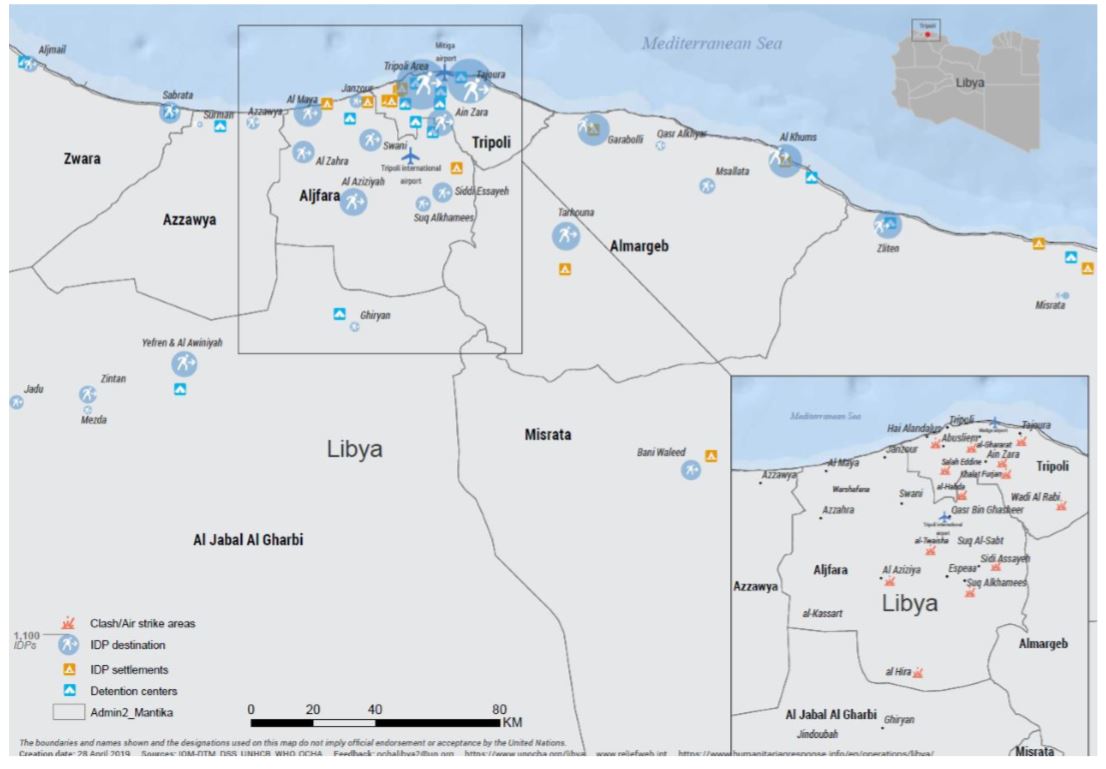
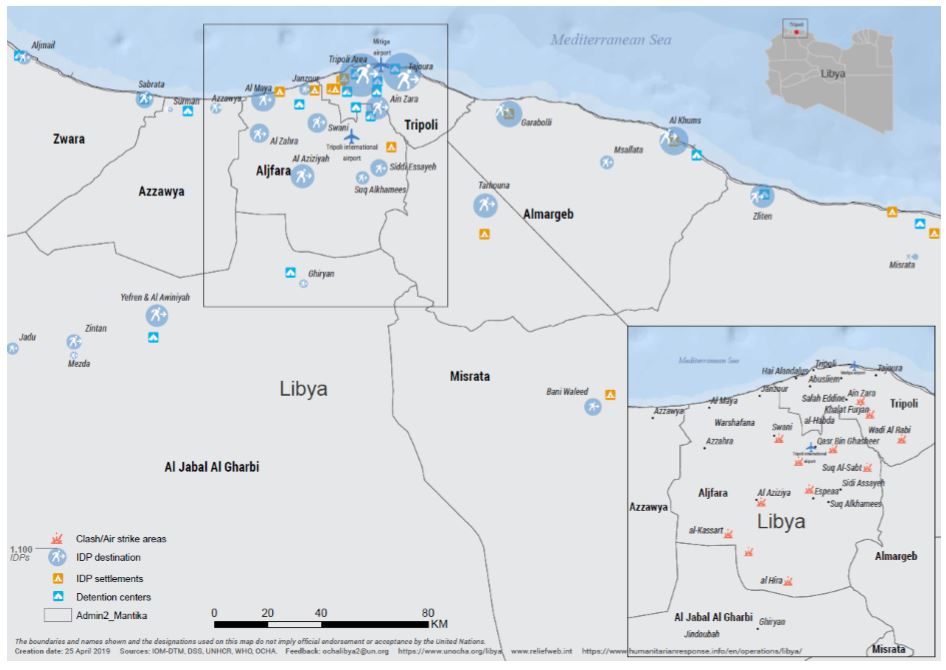
About 1,700 IDP children have been reached with psychosocial assistance and more than 37,500 persons have now fled their homes as a result of the Tripoli around the borders of Tripoli, the latest UN Office for the Coordination of Humanitarian Affairs (OCHA) said yesterday.

The report says that there are at least 90 civilian casualties, including 21 verified fatalities since the beginning of the conflict. These casualties include medical personnel, women and children, and at least one foreign national. It also confirms that more than 37,500 persons have now fled their homes as a result of armed conflict.

The conflict has significantly affected the capacity of hospitals and primary health centres with some medical personnel leaving the health facilities, thus hindering the capacity of the health system to respond to increasing needs. Specialized health workers are particularly needed, the OCHA report said.

RELATED POSTS

Three million illegal immigrants in Libya, 75 % of whom are families, constitute ”settlement” which Libyans reject – illegally transfer US$ 7 billion annually: Interior Minister Trabelsi

Atletico Madrid win Benghazi’s Reconstruction Cup after beating Inter Milan 4-3 on penalties – great political showpiece for Hafter

The report also bemoaned the fact that armed actors and security institutions have restricted freedom of movement and increased security check toward the civilian population. Individuals, including IDPs, originally from the east, have been particularly targeted due to perceived risk of military involvement or political affiliation, it added. 

A humanitarian corridor to transfer 328 refugees and migrants was facilitated on 24 April by a number of Libyan and international aid agencies from the frontline area of Gaser Ben Ghashir detention centre to relatively safer Zawia detention centre.

The OCHA report confirmed that the transfer was conducted after 12 individuals were injured when ‘‘an armed group’’ entered the detention centre the on 23 April. All injured were transferred to hospital on 23 April.  

It adds that this relocation is the fourth organized transfer since the recent escalation of conflict in Libya, with more than 825 refugees and migrants transferred from a number of detention centres in the past two weeks.

The report nevertheless says that concern remains high for some 3,300 refugees and migrants who remain trapped in detention centres close to the front lines. Five detention centres are in areas already engulfed by fighting. Six more are in close proximity to areas where the clashes are taking place. The situation in these detention centres is increasingly desperate with reports of guards abandoning their posts and leaving people trapped inside.

The Gharian detention centre has reportedly been without drinking water for days. The report says that the Khalifa Hafter-led Libyan National Armed (LNA) aligned forces are also reported to be located within the Gharian detention centre, threatening the civilian nature of the site and putting the detainees at even greater risk.

It adds that negotiations are currently ongoing to move more refugees and migrants who are currently in detention centres located in close proximity to the frontlines to safer areas.

With regard to humanitarian access, the OCHA report says that areas south of Ain Zara, Khalat Al-Furjan, Aziziya, Wadi Rabea and Gasr Ben Ghashir ‘‘remain largely inaccessible due to fighting and random shelling’’.

With regards to water, sanitation and hygiene needs, the report says that the populations affected by the conflict – including the approximately 37,600 IDPs in collective shelters and urban settings, the nearly 3,300 refugees and migrants detained in insecure areas and the unknown number of other civilians trapped by frontline fighting – struggle to access safe water for drinking and to meet basic hygiene and sanitation needs.
Tags: featuredhumanitarianIDPs internally displaced peopleKhalifa HafterLNA Libyan National ArmymigrantsRefugeesTripoli fightingUN OCHA United Nations Office for the Coordination of Humanitarian Affairs

Related Posts

Attorney General orders arrests at Jumhouria bank branch for embezzlement
Libya

Tripoli Criminal Court convicts five Waha bank employees for LD 131 million corruption

February 22, 2026
Mental health services in Libya almost non-existent – approximately one million people need mental health care: WHO 2020 report
Libya

WHO confirms elimination of trachoma as a public health problem in Libya – particularly notable given years of political instability and humanitarian challenges on health services

February 21, 2026
Aldabaiba attempts to solidify his position and continues to entrench rentier state with a spree of handouts
Libya

Aldabaiba refutes Italian media reports of another health setback – says he was having a routine checkup coinciding with a Milan visit

February 21, 2026
Libyan Ports fees increased by 235 percent to reflect dinar devaluation
Libya

Khoms Port receives five new Ferrari and Kone Crane 45-ton cranes

February 20, 2026
Malta to open Libya Consulate in weeks – visas, residency permits, flights, bank accounts, seized dinars discussed
Libya

Maltese Embassy participated in a mission in Libya in support of the Libyan National Centre for Emergencies and Disaster Management.

February 20, 2026
Largest-ever Libyan government delegation to visit Washington first week of September
Libya

US working for economic and military integration by bringing together senior officials from eastern and western Libya: Massad Boulos at Security Council

February 19, 2026
Next Post
Libya’s March oil revenues up 20 percent to US$ 1.5 bn largely to Sharara reopening: NOC

Libya’s March oil revenues up 20 percent to US$ 1.5 bn largely to Sharara reopening: NOC

Indiscriminate missile attacks on residential areas have continued during Tripoli fighting in violation of international humanitarian law: UN

Indiscriminate missile attacks on residential areas have continued during Tripoli fighting in violation of international humanitarian law: UN

Top Stories

  • Aldabaiba attempts to solidify his position and continues to entrench rentier state with a spree of handouts

    Aldabaiba refutes Italian media reports of another health setback – says he was having a routine checkup coinciding with a Milan visit

    0 shares
    Share 0 Tweet 0
  • US working for economic and military integration by bringing together senior officials from eastern and western Libya: Massad Boulos at Security Council

    0 shares
    Share 0 Tweet 0
  • No progress in Libya’s latest political Roadmap: UNSMIL head Tetteh

    0 shares
    Share 0 Tweet 0
  • Newly created Libyan United Airlines reveals logo – stresses it is a privately owned airline

    0 shares
    Share 0 Tweet 0
  • Aldabaiba calls on CBL Governor to halt all 2026 project spending across Libya – until the newly US-brokered unified spending agreement is adhered to

    0 shares
    Share 0 Tweet 0
ADVERTISEMENT
LibyaHerald

The Libya Herald first appeared on 17 February 2012 – the first anniversary of the Libyan Revolution. Since then, it has become a favourite go-to source on news about Libya, for many in Libya and around the world, regularly attracting millions of hits.

Recent News

Surman Chamber of Commerce receives decision from General Union to commence its activities

HoR report on fuel shortages concludes that fuel shortages are due to reduction in the number of fuel shipments and not a fabricated crisis

Sitemap

  • Why subscribe?
  • Terms & Conditions
  • FAQs
  • Copyright & Intellectual Property Rights
  • Subscribe now

Newsletters

    Be the first to know latest important news & events directly to your inbox.

    Sending ...

    By signing up, I agree to our TOS and Privacy Policy.

    © 2022 LibyaHerald - Powered by Sparx Solutions.

    Welcome Back!

    Login to your account below

    Forgotten Password? Sign Up

    Create New Account!

    Fill the forms below to register

    *By registering into our website, you agree to the Terms & Conditions and Privacy Policy.
    All fields are required. Log In

    Retrieve your password

    Please enter your username or email address to reset your password.

    Log In
    No Result
    View All Result
    • Login
    • Sign Up
    • Libya
    • Business
    • Advertising
    • About us
    • BusinessEye Magazine
    • Letters
    • Features
    • Why subscribe?
    • FAQs
    • Contact

    © 2022 LibyaHerald - Powered by Sparx Solutions.

    This website uses cookies. By continuing to use this website you are giving consent to cookies being used. Visit our Privacy and Cookie Policy.