In recent years, the south Tripoli suburb of Hadba Mashrua has mushroomed from what were originally orange and olive groves into a vast suburb, one of the biggest in the city. The streets are dusty and, in some cases, unpaved. There seems little obvious urban planning. But the place is vibrant and full of traffic. And among the seemingly random sprawl of shops, homes and other buildings, hiding out in the open and unknown to many, there is something of a jewel of commitment and hope.
The Holy Quran Academy, which opened its doors in 2017, is not a standard higher educational institution, let alone a formal college or university. Nor does it, as the name suggests, concern itself purely with religious studies, although that what some of those using its facilities are indeed pursuing. In fact, the largest group of the hundreds of students who pass through its doors each week are studying medicine. Others are learning computer sciences and IT, law or other subjects. Moreover, officially they are doing it elsewhere; most of them are actually at the University of Tripoli, some kilometres away in Sidi Mesri.
The academy is unique. It gives them the space and the facilities to study. It is a sort of academic sanctuary, a place where students can work undisturbed but in comfort, with almost everything they need at hand. In a city where long power cuts mean not only no air-conditioning but also no internet and functioning computers, study can be difficult, if not impossible. Not at the academy. Permanent power is ensured by oil-fired generators and with it, air-conditioning and internet that works. The generators ensure there are no outages whatsoever.
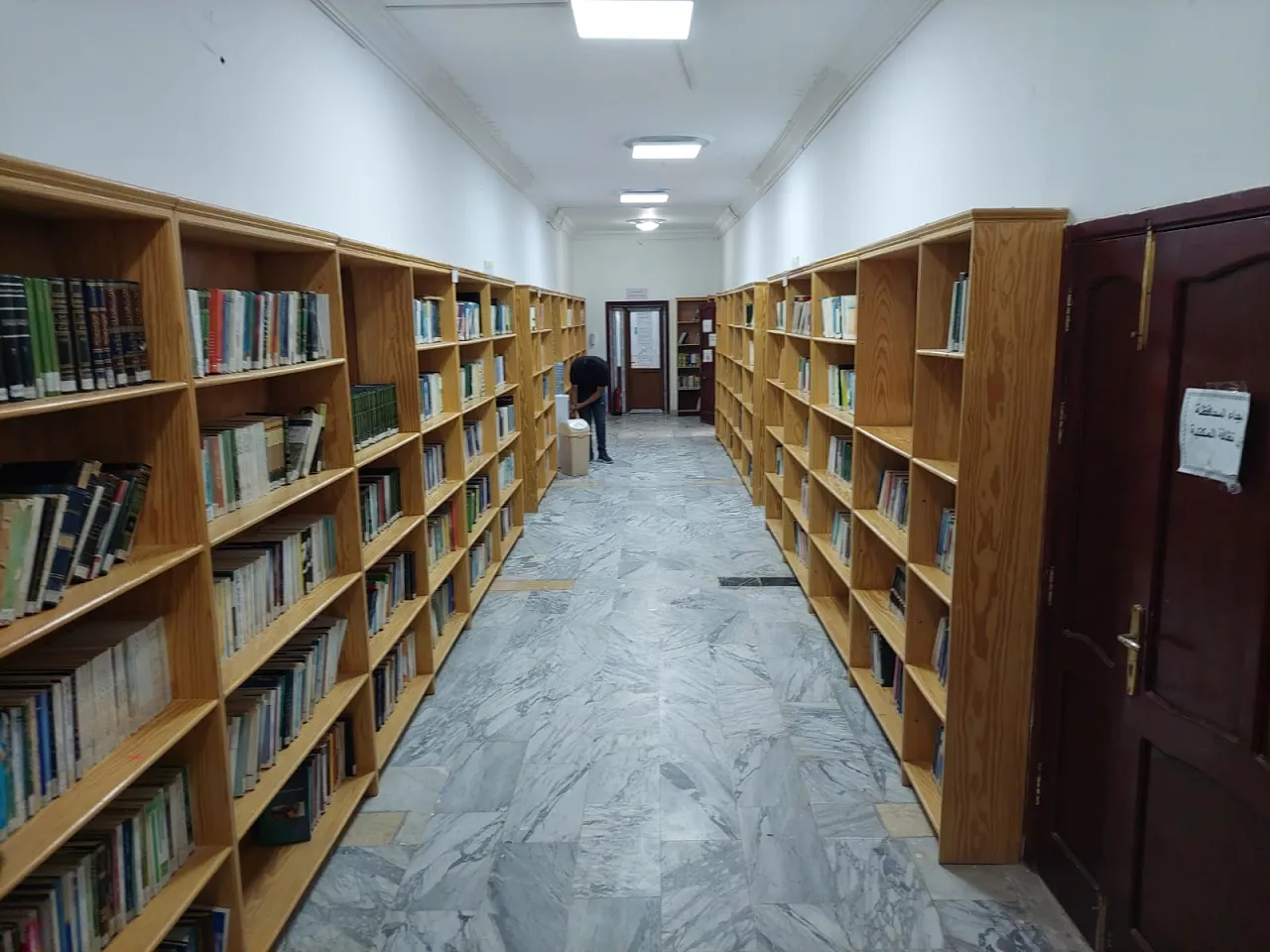 Books line the corridors on every floor and study room (Photo: Sami Zaptia)
The four-storey building (a fifth is being built because of the need to expand) is in fact also a massive library.is in fact also a massive library. Shelves of reference and other books for the students to use line the corridors and the many study rooms on every floor. There are over 200,000 volumes available and as many more still to be unpacked, catalogued and shelved. Staff say there are more books at the academy than at Tripoli University.
The Holy Quran Academy says over a thousand students pass through its doors every week. It is open from 9am to 9.30pm, longer than the university. Some students stay a few hours, others all day. And there are free meals, snacks and refreshments, with the canteen providing over 100 lunches a day at no cost to the students.
However, a first-time visitor arriving in the middle of the morning, might find that surprising, or even suspect that there is hardly anyone around. There is a hush throughout the building. But it is deceptive. The study rooms are in fact full of young students quietly working away and with an intensity that is impressive; males on the first floor, females on the second. In one room alone, on the morning I visited, there were ten students, almost all of them studying medicine. There were seven each in two other rooms, in a fourth eight, and so on. In the hour that I visited, I counted 115 students. No one was talking, just working on their laptops, writing notes or drawing sketches in their notebooks. And no noise at all.
The academy is the brainchild of Omar Swehli, a prominent Libyan businessman who is doing something that few others in Libya or indeed anywhere else in the world have opted to do. He is using his money earned during his business life to help build a new generation of highly-educated Libyans who can contribute to the country’s future, in particular doctors and other healthcare professionals. The result is a free facility for students that would be remarkable in any country.
“The conditions here are very good, especially given the electricity shortages,” said medical student Mohamed who was a couple of weeks away from exams and hoped to graduate at the end of the year.
A similar vote of confidence came from an IT student: “Here I can study three times more than I can do at home in Hadba.”
“It’s calm here and there’s Wi-Fi and the food’s very good,”, said first-year medical student, also called Mohamed, who hails from Bani Walid. “I appreciate it a lot,” he added, saying that he turns up almost every day.
Another explained that he also came daily, except Fridays, staying seven hours each time. One of the results was that he had also made a number of new friends. “I’ve got to know friends here that I did not know at the university.”
For Hussam, a fourth-year medical student originally from Syria, it was his first visit to the academy. He had heard about it on Facebook. He definitely would be coming again, he said.
It is not simply a place where students can study in peace and at ease; it looks as if it may be transforming itself into a college in its own right. There are lectures, almost entirely at present on medical topics, either in a lecture halls in an adjacent building or online, in individual sound-proofed booths on the top floor of the main academy building. These are given by doctors and academics who provide their time free of charge. The day I visited there was a doctor from Tripoli’s Eye Hospital giving a lecture to some 20 or so students on ophthalmology. But there may soon be lectures on other subjects and a second lecture hall is under construction. Both can accommodate up to 250 students. There are also hopes to start providing, once again free of charge, English-language courses for medical students.
The lecturers and a few others may provide their services for free, but the academy is a fully-funded, professional operation. Retired now from business, Omar Swehli, nonetheless, has a full-time, hands-on role running the academy and there are administrative staff, cooks, cleaners and others, some 20 employees in all on the payroll.
But that is not the end of it. Not only is the Holy Quran Academy an apparent college in the making, it is also now providing free medical consultations for local residents. In the adjacent buildings there are not only the lecture halls, there are plans for six clinics, staffed by doctors offering their services for free. The first started in June with some 25 patients a day.
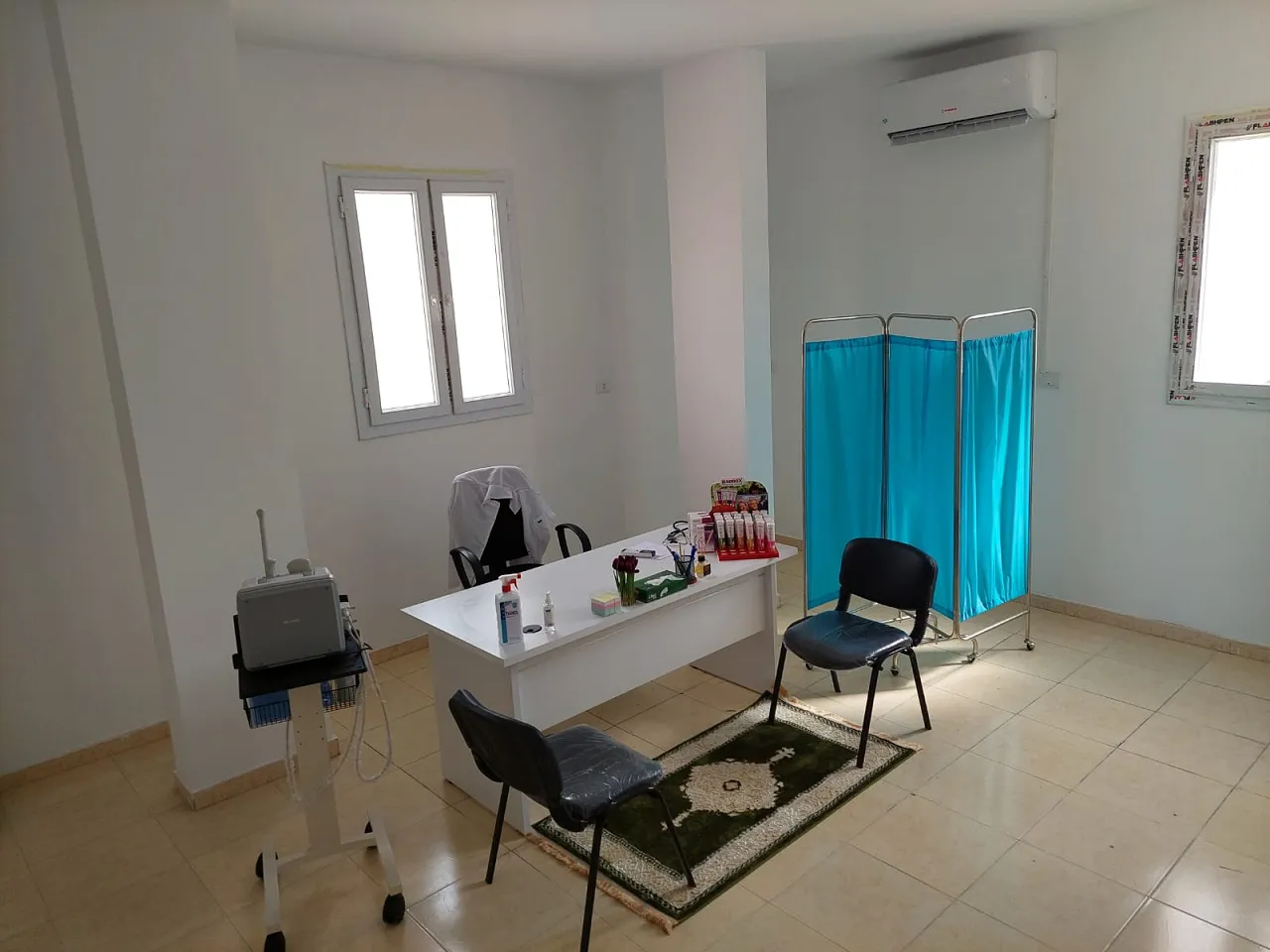 One of the doctors' consulting rooms (Photo: Sami Zaptia)
For Swehli, retirement is no more than a change of direction. After a life devoted to business, he is passionate about the academy and has constant plans for its growth, even though, now in his 70s, he explains that he is going blind. That should be an inspiration to others. In his blindness he has a vision that few others in the country can match.
The world has become all too used to hearing or reading bad news from Libya. But amid the reports of clashes, division, corruption, political sabotage and economic stagnation, there are good news stories, stories of kindness, care and generosity. This is one of them.
The academy is a monument to one man’s determination to help young Libyans. It is not difficult to imagine that one day, many of Libya’s future doctors, its lawyers, IT specialists and even politicians will be able to say that they attended the Holy Quran Academy.