No Result
View All Result
Sunday, February 22, 2026
23 °c
Tripoli
24 ° Sat
24 ° Sun
  • Advertising
  • Contact
LibyaHerald
  • Home
  • Libya
  • Business
  • Opinion
  • Magazine
  • Advertising
  • Login
  • Register
SUBSCRIBE
  • Home
  • Libya
  • Business
  • Opinion
  • Magazine
  • Advertising
  • Login
  • Register
No Result
View All Result
LibyaHerald
No Result
View All Result
Home Business

Libya will not go bankrupt if reforms and austerity implemented: CBL Governor Hibri

bySami Zaptia
November 1, 2015
Reading Time: 3 mins read
A A

By Libya Herald reporter.
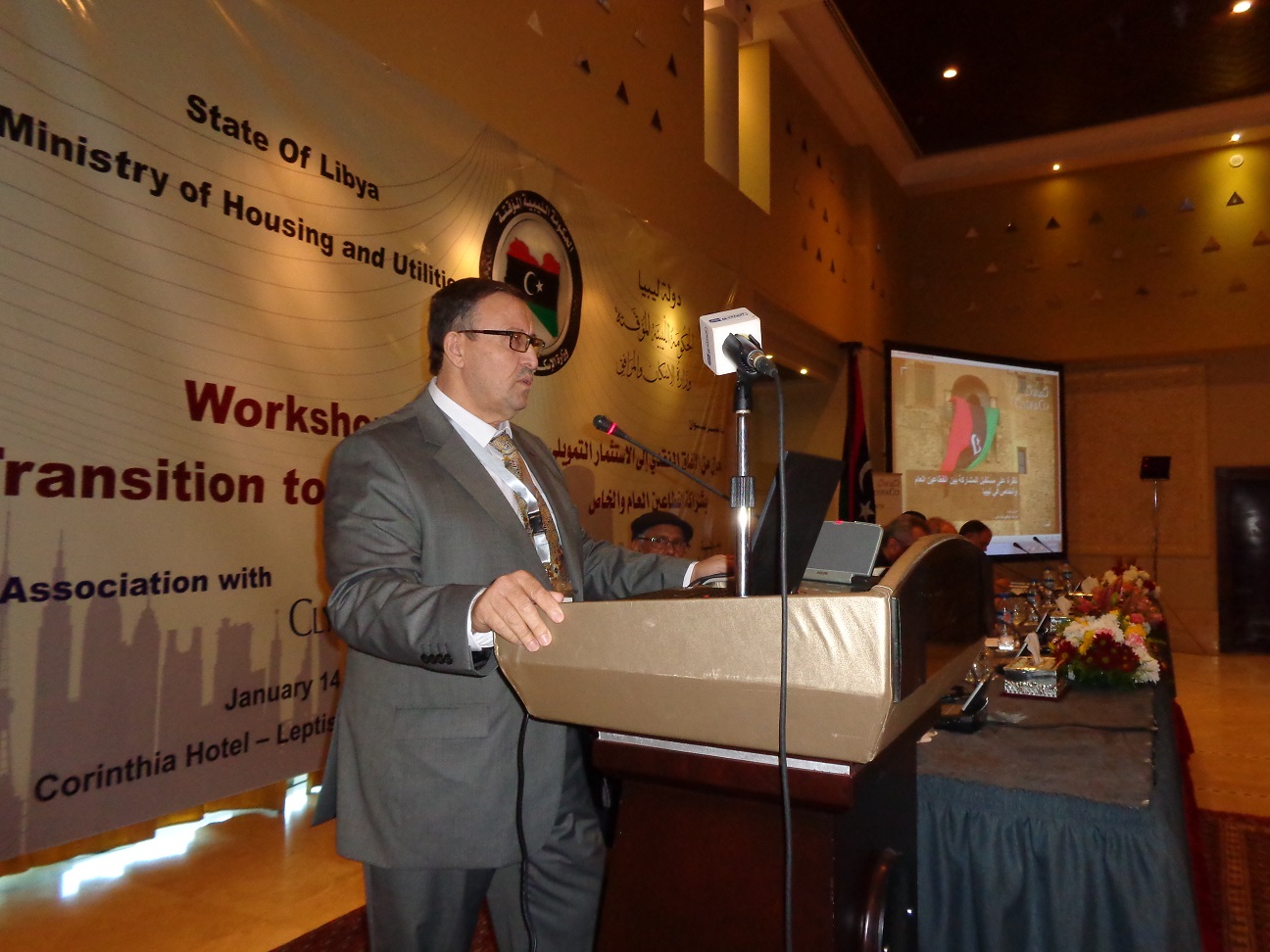
CBL Governor, Ali Salem Hibri is recognized by the IMF as the legitimate representative of Libya  (Archive photo: Sami Zaptia).
Beida-based CBL Governor, Ali Salem Hibri does not think Libya will go bankrupt if it implements reforms (Archive photo: Sami Zaptia).

Tunis, 01 November 2015:

‘’Libya’s economy is a sick economy’’ and it ‘’is in intensive care’’, declared the Central . . .[restrict]Bank of Libya (CBL) Governor Ali Salem Hibri.

Speaking on the Amman-based privately-owned Libya’s Channel on Friday Hibri said that ‘’the doctor needs to diagnose, give medicine or surgery and allow recuperation of Libya’s economy. There are no fast solutions to Libya’s financial problems’’, he stressed adding that it will ‘’need 3-7 years. There are no magic solutions’’, he explained.

Hibri is Governor of the Al-Beida based CBL representing the only internationally recognized Libyan government and parliament based in the east of the country.

RELATED POSTS

Aldabaiba calls on CBL Governor to halt all 2026 project spending across Libya – until the newly US-brokered unified spending agreement is adhered to

There is no shortage of food supplies in the Libyan marketplace: Customs Authority

He added that ‘’there will be a full recovery’’ of Libya’s economy but that ‘’bankruptcy is far away. Central banks don’t go bankrupt’’, he stressed.

The CBL Governor explained that Libya’s financial woes were as a result of the fall in Libya’s oil production, the fall in international crude oil prices as well as the expansion of public sector spending and corruption.

As a result of a loss of confidence in the economy Libyans are keeping their cash away from the banks which is adding to the economic crises, he added.

Libya’s oil production has crashed down from around 1.5 million barrels per day in 2013 to between 300,000 to 400,000 bpd whilst crude oil prices have crashed from over US$ 100 pb to under US$ 50 pb.

This has resulted in Libya’s oil revenues shrinking from around US$ 50-60 billion to around US$ 7-10 billion per year. This leaves a deficit of US$ 10 bn in Libya’s budget which is made up from foreign currency reserves, Hibri explained.

Hibri said that Libya had US$ 87 billion of foreign currency reserves all kept abroad in triple A rated banks across 38 different countries such as the USA, UK Germany etc. None of the foreign currency was kept in Libya, he added.

Regarding the possibility of Libya needing to seek international loans soon if it exhausted its foreign currency reserves, Hibri said that this was unlikely. He felt that Libya had reserves for about four years and oil reserves of 47 billion barrels of oil.

Hibri felt that the ‘’bankruptcy’’ scenario was marketed by politicians to force a political solution and consensus between the two main warring political parties.

The CBL Governor said that Libya needed to gain control over its budget deficit and its balance of payments deficit. In other words, it needed to implement austerity measures and reforms to reduce its LD and foreign currency spending in line with its actual revenues.

Looking forward, Hibri said that having allowed enough time (for both conflicting political parties) to reach a consensus he says that there is no option but for the eastern-based authorities to start selling their own oil.

Hibri acknowledged that whilst it is true that all the money from historic oil contracts signed with the Tripoli authorities was being paid to the Tripoli National Oil Corporation (NOC), he claimed that ‘’some new oil contracts signed since the conference in Malta will start to be paid to the eastern-based NOC’’.

The CBL Governor also admitted that there is cooperation between the Tripoli and Beida central banks. He also claimed that his Beida-based CBL could have easily printed its own money and he could have sold its gold reserves to create a separate independent CBL in the east, but that would have destroyed the Libyan banking system.

Hibri said that there needed to be reform in the way Libya’s hard currency was spent. He favoured different exchange rates for essential and non-essential imports. In effect he was favouring a partial revaluation of the LD exchange rate.

He also felt that the black market FX rate could be solved in 3-6 months anticipating that it will fall from about 3.6 to 3.8 per US$ to about 1.8 per US$. This was based on the fact that local FX consumption was only about US$ 100.

He attacked the decision by the Tripoli-based CBL to freeze the use of foreign currency debit cards adding that this only increased the black market price of FX. Hibri said that corruption in Tripoli was the main cause of the high FX rate. He suggested that only one bank branch is allowed to issue FX in order that the CBL can control corruption.

  [/restrict]

Tags: Al-Beidabudget deficitCBL Central Bank of LibyaCBL Governor Ali Salem HibrideficitfeaturedFX foreign currency exchangeoil

Related Posts

LBC leading delegation to Miami for America’s Food and Beverage Show – 18 to 20 September
Business

LBC and Libyan African Council for Sub-Saharan Countries held its first official meeting – an action plan to enhance Libya’s economic presence in Africa is agreed

February 21, 2026
ESDF and subsidiary LIDCO hold meeting with KPMG to follow up on financial evaluation within ESDF’s programme for subsidiary companies
Business

LIDCO continues construction on 8,500 car multistorey carpark as part of Tripoli Gate 1 Project

February 21, 2026
GNU to take oath at Benghazi HoR session and budget to be approved at Tripoli session: GNU
Business

Aldabaiba calls on CBL Governor to halt all 2026 project spending across Libya – until the newly US-brokered unified spending agreement is adhered to

February 21, 2026
Tripoli based Military Industries Organisation opens “Libyan Inventor” office
Business

Military Industrialization Organisation delivers 7,000 cooking gas cylinders it has manufactured locally to Brega Oil Marketing Company

February 20, 2026
Economy Ministry creating e-regulations website for registering companies
Business

One-Stop Shop system for company registration to be activated – again!

February 20, 2026
71 commercial vessels were received by the Julyana Free Zone Port in August
Business

Julyana Free Port meet high-level British delegation visiting Benghazi

February 20, 2026
Next Post

Smuggled alcohol seized in Tobruk

Saadi trial adjourned again

Top Stories

  • Aldabaiba attempts to solidify his position and continues to entrench rentier state with a spree of handouts

    Aldabaiba refutes Italian media reports of another health setback – says he was having a routine checkup coinciding with a Milan visit

    0 shares
    Share 0 Tweet 0
  • Seven companies successful as Libya announces results of first public bidding round for oil and gas exploration‎ in 17 years

    0 shares
    Share 0 Tweet 0
  • US working for economic and military integration by bringing together senior officials from eastern and western Libya: Massad Boulos at Security Council

    0 shares
    Share 0 Tweet 0
  • No progress in Libya’s latest political Roadmap: UNSMIL head Tetteh

    0 shares
    Share 0 Tweet 0
  • Military Industrialisation Organisation signs major strategic agreement with Turkish company to begin a new industrial phase

    0 shares
    Share 0 Tweet 0
ADVERTISEMENT
LibyaHerald

The Libya Herald first appeared on 17 February 2012 – the first anniversary of the Libyan Revolution. Since then, it has become a favourite go-to source on news about Libya, for many in Libya and around the world, regularly attracting millions of hits.

Recent News

WHO confirms elimination of trachoma as a public health problem in Libya – particularly notable given years of political instability and humanitarian challenges on health services

Aldabaiba refutes Italian media reports of another health setback – says he was having a routine checkup coinciding with a Milan visit

Sitemap

  • Why subscribe?
  • Terms & Conditions
  • FAQs
  • Copyright & Intellectual Property Rights
  • Subscribe now

Newsletters

    Be the first to know latest important news & events directly to your inbox.

    Sending ...

    By signing up, I agree to our TOS and Privacy Policy.

    © 2022 LibyaHerald - Powered by Sparx Solutions.

    Welcome Back!

    Login to your account below

    Forgotten Password? Sign Up

    Create New Account!

    Fill the forms below to register

    *By registering into our website, you agree to the Terms & Conditions and Privacy Policy.
    All fields are required. Log In

    Retrieve your password

    Please enter your username or email address to reset your password.

    Log In
    No Result
    View All Result
    • Login
    • Sign Up
    • Libya
    • Business
    • Advertising
    • About us
    • BusinessEye Magazine
    • Letters
    • Features
    • Why subscribe?
    • FAQs
    • Contact

    © 2022 LibyaHerald - Powered by Sparx Solutions.

    This website uses cookies. By continuing to use this website you are giving consent to cookies being used. Visit our Privacy and Cookie Policy.