By Alaa Murabit.
22 July 2015:
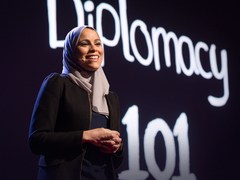
Speaking at a TED talk event on women, Alla Murabit gave her experience as a Muslim woman trying to reclaim her religion.
''Every day, I work to amplify the voices of women and to highlight their experiences and their participation in peace processes and conflict resolution, and because of my work, I recognize that the only way to ensure the full participation of women globally is by reclaiming religion''.
''As a young Muslim woman, I am very proud of my faith. It gives me the strength and conviction to do my work every day. It's the reason I can be here in front of you. But I can't overlook the damage that has been done in the name of religion, not just my own, but all of the world's major faiths. The misrepresentation and misuse and manipulation of religious scripture has influenced our social and cultural norms, our laws, our daily lives, to a point where we sometimes don't recognize it''.
''Growing up, I saw my parents, both religiously devout and spiritual people, pray and praise God for their blessings. I was never subjected to religion through a cultural lens. I was treated the same, the same was expected of me. I was never taught that God judged differently based on gender. And my parents' understanding of God as a merciful and beneficial friend and provider shaped the way I looked at the world''.
''When I was 15 in 2005, I moved from Canada to Libya. I very quickly became introduced to the cultural aspect of religion. The words "haram" -- meaning religiously prohibited -- and "aib" -- meaning culturally inappropriate -- were exchanged carelessly, as if they meant the same thing and had the same consequences. And I found myself in conversation after conversation with classmates and colleagues, professors, friends, even relatives, beginning to question my own rule and my own aspirations. And even with the foundation my parents had provided for me, I found myself questioning the role of women in my faith''.
''Upon research it surprised me how easy it was to find women in my faith who were leaders, who were innovative, who were strong - politically, economically, even militarily. (Our Lady) Khadija, the prophets wife, for example, financed the Islamic movement in its infancy. We wouldn't be here if it weren't for her. So why weren't we learning about her? Why weren't we learning about these women? Why were women being relegated to positions which predated the teachings of our faith? And why, if we are equal in the eyes of God, are we not equal in the eyes of men?''
''To me, it all came back to the lessons I had learned as a child. The decision maker, the person who gets to control the message, is sitting at the table, and unfortunately, in every single world faith, they are not women. Religious institutions are dominated by men and driven by male leadership, and they create policies in their likeness, and until we can change the system entirely, then we can't realistically expect to have full economic and political participation of women. Our foundation is broken. My mom actually says, you can't build a straight house on a crooked foundation.''
''In 2011, the Libyan revolution broke out, and my family was on the front lines. And there's this amazing thing that happens in war, a cultural shift almost, very temporary. And it was the first time that I felt it was not only acceptable for me to be involved, but it was encouraged. It was demanded. Myself and other women had a seat at the table. We weren't holding hands or a medium. We were part of decision making. We were information sharing. We were crucial. And I wanted and needed for that change to be permanent.''
''Turns out, that's not that easy. It only took a few weeks before the women that I had previously worked with were returning back to their previous roles, and most of them were driven by words of encouragement from religious and political leaders, most of whom cited religious scripture as their defense. It's how they gained popular support for their opinions.''
''So initially, I focused on the economic and political empowerment of women. I thought that would lead to cultural and social change. It turns out, it does a little, but not a lot. I decided to use their defense as my offense, and I began to cite and highlight Islamic scripture as well.''
''In 2012 and 2013, my organization led the single largest and most widespread campaign in Libya. We entered homes and schools and universities, even mosques. We spoke to 50,000 people directly, and hundreds of thousands more through billboards and television commercials, radio commercials and posters.''
''And you're probably wondering how a women's rights organization was able to do this in communities which had previously opposed our sheer existence. I used scripture. I used verses from the Quran and sayings of the Prophet, Hadiths, his sayings which are, for example, "The best of you is the best to their family." "Do not let your brother oppress another." For the first time, Friday sermons led by local community imams promoted the rights of women. They discussed taboo issues, like domestic violence. Policies were changed. In certain communities, we actually had to go as far as saying the International Human Rights Declaration, which you opposed because it wasn't written by religious scholars, well, those same principles are in our book. So really, the United Nations just copied us.''
''By changing the message, we were able to provide an alternative narrative which promoted the rights of women in Libya. It's something that has now been replicated internationally, and while I am not saying it's easy -- believe me, it's not. Liberals will say you're using religion and call you a bad conservative. Conservatives will call you a lot of colorful things. I've heard everything from, "Your parents must be extremely ashamed of you" -- false; they're my biggest fans -- to "You will not make it to your next birthday" -- again wrong, because I did. And I remain a very strong believer that women's rights and religion are not mutually exclusive. But we have to be at the table. We have to stop giving up our position, because by remaining silent, we allow for the continued persecution and abuse of women worldwide. By saying that we're going to fight for women's rights and fight extremism with bombs and warfare, we completely cripple local societies which need to address these issues so that they're sustainable.''
''It is not easy, challenging distorted religious messaging. You will have your fair share of insults and ridicule and threats. But we have to do it. We have no other option than to reclaim the message of human rights, the principles of our faith, not for us, not for the women in your families, not for the women in this room, not even for the women out there, but for societies that would be transformed with the participation of women. And the only way we can do that, our only option, is to be, and remain, at the table. ''
Alaa Murabit is founder of Libyan women’s NGO Voice of Libyan Women and acts as advisor to numerous international security boards, think tanks, and organizations. Most recently she was nominated to the UN Security Council Resolution 1325 (women, peace and security) Global Advisory Board, the UN Women Global Advisory Board, and Harvard University’s “Everywoman, Everywhere” initiative. She was named the “International Trust Women Hero 2014? by The New York Times and “One of 25 Women Under 25 to Watch” by Newsweek